
-p-2000.png)


13 Best AI SEO Tools We've Tested for 2026
TL;DR
- AI SEO has evolved beyond keyword rankings. In 2026, brands also need visibility in ChatGPT, Google AI Overviews, Gemini, Perplexity, and other AI search experiences.
- The best AI SEO tools now combine traditional SEO, content optimization, and AI visibility tracking.
- Semrush leads as the most complete AI SEO platform for SEO, content, and AI search monitoring.
- Ahrefs remains the strongest choice for backlink intelligence and competitor research.
- Surfer SEO is still one of the best tools for content optimization and AI-ready content creation.
- Enterprise teams should evaluate dedicated GEO (Generative Engine Optimization) platforms like Profound.
- Agencies can often achieve the best value with SE Ranking or Rankability.
- No single tool does everything perfectly. The most successful SEO teams build a stack that combines SEO data, content optimization, and AI visibility monitoring.
The Best AI SEO Tools We've Tested for 2026
Search is changing faster than at any point in the last decade.
For years, SEO focused on ranking webpages in Google's traditional search results. Today, users increasingly get answers directly from AI systems such as ChatGPT, Google AI Overviews, Gemini, Perplexity, and Copilot.
This shift has created two new disciplines:
- AEO (Answer Engine Optimization) entails optimizing content to appear in AI-generated answers.
- GEO (Generative Engine Optimization) increases brand visibility across generative AI platforms.
Traditional SEO is still important. However, ranking first is no longer sufficient if AI systems reference competitors rather than your brand. This is why AI SEO tools have become indispensable.
The best platforms now assist marketers in identifying keywords and topics, optimizing content, analyzing competitors, monitoring backlinks, tracking AI visibility, measuring brand mentions across AI platforms, and so on. After considering the most recent features, pricing, user feedback, and AI-search capabilities, these are the best AI SEO tools for 2026.
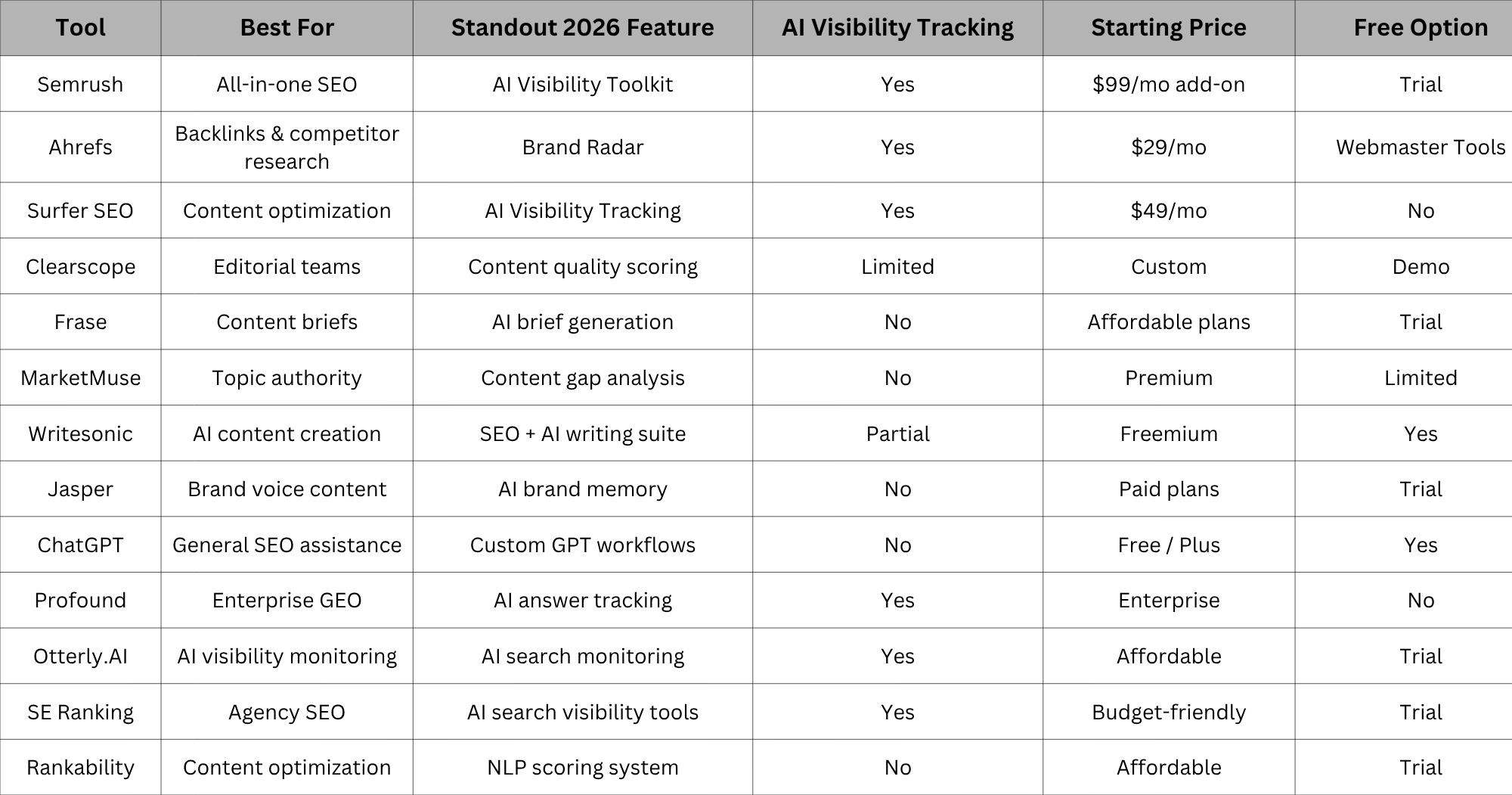
13 Best AI SEO Tools: A Quick Comparison Table
1. Semrush
Best For: All-in-One AI SEO Platform
Semrush stands out because it combines traditional SEO, content marketing, competitor intelligence, and AI-search visibility in a single platform. Instead of managing multiple tools, teams can monitor rankings, discover content opportunities, analyze competitors, and track AI-generated search mentions from one dashboard.
Ratings & Trust Signals
- G2 Rating: 4.5+/5
- Trusted by large enterprises, agencies, and in-house marketing teams
- Used by brands ranging from startups to Fortune 500 companies
Core Features
- Keyword research and clustering
- AI Visibility Tracking
- Analyzing the competitors
- Backlink auditing
- Site health monitoring
- Content optimization tools
- Position tracking
- AI-generated content assistance
Integrations
- Google Analytics
- Google Search Console
- WordPress
- Looker Studio
- Social media platforms
Target Use Case
Semrush is ideal for marketing teams that want one platform to manage SEO, content, competitor research, and AI-search visibility.
Pros
- Comprehensive feature set
- Strong AI visibility tracking
- Excellent competitor intelligence
- Enterprise-grade reporting
Cons
- Can be expensive for smaller businesses
- Learning curve for beginners
2. Ahrefs
Best For: Backlink & Competitor Research
Ahrefs remains the industry's benchmark for backlink intelligence. In 2026, the platform has expanded beyond backlinks with AI-focused features such as Brand Radar, helping businesses understand how brands and topics appear across search ecosystems.
Its massive link database continues to be one of the most trusted resources for SEO professionals.
Ratings & Trust Signals
- G2 Rating: 4.6+/5
- Widely used by SEO agencies and enterprise teams
- One of the largest backlink databases available
Core Features
- Backlink analysis
- Competitor research
- Site Explorer
- Keyword Explorer
- Content Gap analysis
- Brand monitoring
- Rank tracking
Integrations
- Google Search Console
- Looker Studio
- API access
Target Use Case
Perfect for SEO professionals focused on link building, competitive intelligence, and market research.
Pros
- Best backlink database in the market
- Powerful competitor insights
- Excellent keyword research
Cons
- Content optimization tools are less advanced than Surfer or Clearscope
- Limited AI writing capabilities
3. Surfer SEO
Best For: On-Page Content Optimization
Surfer SEO continues to dominate content optimization by helping marketers create pages that align with search intent and ranking patterns.
Its newest AI visibility features help identify whether content is likely to perform in AI-generated search experiences, making it one of the strongest content-focused AI SEO tools available.
Ratings & Trust Signals
- G2 Rating: 4.8+/5
- Trusted by content marketers and SEO agencies
- Used by thousands of publishers worldwide
Core Features
- Content Editor
- NLP-based optimization
- Keyword clustering
- AI article generation
- SERP analysis
- AI visibility insights
Integrations
- Google Docs
- WordPress
- Jasper
- ChatGPT
Target Use Case
Best for content teams publishing SEO-focused articles at scale.
Pros
- Easy-to-use optimization workflow
- Excellent content scoring
- Fast content production
Cons
- Limited technical SEO capabilities
- Not a complete SEO platform
4. Clearscope
Best For: Editorial Quality
Clearscope focuses on helping teams create authoritative, high-quality content rather than simply increasing keyword density.
Its recommendation engine analyzes top-performing content and provides guidance that improves relevance, comprehensiveness, and topical coverage.
Ratings & Trust Signals
- G2 Rating: 4.9+/5
- Popular among enterprise content teams
- Frequently used by publishers and SaaS companies
Core Features
- Content grading
- Topic recommendations
- Competitive content analysis
- Keyword relevance scoring
- Editorial workflow support
Integrations
- Google Docs
- WordPress
- HubSpot
Target Use Case
Best suited for editorial teams focused on quality and topical authority.
Pros
- Excellent content quality recommendations
- Easy for writers to follow
- Strong enterprise adoption
Cons
- Premium pricing
- Limited technical SEO functionality
5. Frase
Best For: Budget Brief Builder
Frase has built a strong reputation for simplifying content planning. The platform excels at creating detailed content briefs in minutes, helping teams reduce research time significantly.
For businesses with limited budgets, Frase offers one of the best balances between affordability and functionality.
Ratings & Trust Signals
- G2 Rating: 4.8+/5
- Strong reviews among freelancers and small teams
Core Features
- AI content briefs
- SERP research
- AI writing assistance
- Question research
- Topic clustering
Integrations
- Google Docs
- WordPress
Target Use Case
Ideal for content marketers who need to speed up planning and briefing workflows.
Pros
- Affordable pricing
- Excellent content brief generation
- Beginner-friendly
Cons
- Fewer advanced SEO features
- Limited enterprise reporting
6. MarketMuse
Best For: Topical Authority
MarketMuse focuses on helping brands build expertise across entire subject areas rather than individual keywords.
The platform identifies content gaps, recommends supporting topics, and helps businesses establish stronger topical authority—a factor becoming increasingly important for both traditional search and AI-generated answers.
Ratings & Trust Signals
- Highly regarded among enterprise content strategists
- Frequently used by large publishing organizations
Core Features
- Content inventory analysis
- Topic authority scoring
- Content planning
- Competitive analysis
- Gap identification
Integrations
- WordPress
- Google Analytics
Target Use Case
Best for organizations building extensive content libraries and topic clusters.
Pros
- Strong topical authority analysis
- Strategic content planning capabilities
- Excellent for long-term SEO growth
Cons
- Higher learning curve
- Premium pricing
7. Writesonic
Best For: End-to-End AI Content Engine
Writesonic has evolved from a simple AI writer into a complete content marketing platform. It combines AI content generation, SEO optimization, research assistance, and publishing workflows.
For teams seeking an all-in-one content creation solution, Writesonic offers substantial value.
Ratings & Trust Signals
- G2 Rating: 4.7+/5
- Popular among startups, agencies, and content teams
Core Features
- AI article generation
- SEO optimization
- Content planning
- AI chatbot assistance
- Brand voice management
Integrations
- WordPress
- Zapier
- Google Search Console
Target Use Case
Best for teams producing large volumes of content efficiently.
Pros
- Strong AI writing capabilities
- User-friendly interface
- Multiple content formats supported
Cons
- Content still requires human editing
- SEO insights less robust than dedicated SEO tools
8. Jasper
Best For: Brand-Voice Writing at Scale
Jasper has positioned itself as one of the leading AI writing platforms for businesses that need consistent content across multiple channels. While many AI tools can generate content, Jasper's strength lies in maintaining a company's brand voice across blog posts, landing pages, email campaigns, social media content, and marketing materials.
In 2026, Jasper's brand memory and style guide capabilities make it particularly valuable for organizations producing content at scale. Teams can train Jasper on company messaging, tone, product information, and content guidelines to ensure consistency across all outputs.
Ratings & Trust Signals
- G2 Rating: 4.7+/5
- Used by thousands of marketing teams globally
- Strong adoption among SaaS and enterprise organizations
Core Features
- AI content generation
- Brand voice training
- Marketing campaign creation
- Workflow automation
- Collaboration tools
- Content templates
Integrations
- Google Docs
- Surfer SEO
- WordPress
- HubSpot
- Grammarly
Target Use Case
Best for businesses that need high-volume content production while maintaining a consistent brand voice.
Pros
- Excellent brand consistency
- Strong collaboration features
- Enterprise-ready workflows
Cons
- Limited SEO research capabilities
- Requires external SEO tools for optimization
9. ChatGPT
Best For: Versatile, Prompt-Driven SEO Assistance
ChatGPT has become a core part of many SEO workflows. While it is not a dedicated SEO platform, its flexibility makes it one of the most useful AI tools for SEO professionals.
Marketers use ChatGPT for keyword clustering, content ideation, content briefs, schema generation, title tag creation, internal linking suggestions, content audits, and workflow automation.
Custom GPTs and advanced reasoning capabilities have further expanded its usefulness for SEO teams.
Ratings & Trust Signals
- One of the most widely used AI tools globally
- Millions of professional users
- Extensive ecosystem of custom workflows
Core Features
- Content ideation
- Keyword clustering
- Content outlining
- SEO audits
- Schema markup generation
- Prompt-driven automation
Integrations
- Zapier
- Google Workspace
- CRM platforms
- Custom APIs
Target Use Case
Ideal for SEO professionals seeking a flexible assistant that can support research, planning, analysis, and content creation.
Pros
- Extremely versatile
- Affordable entry point
- Rapid workflow support
Cons
- No native SEO database
- Requires verification of outputs
- No ranking or backlink tracking
10. Profound
Best For: Enterprise GEO and AI Answer Tracking
Profound is one of the most specialized platforms in the emerging Generative Engine Optimization (GEO) category.
Rather than focusing on rankings, Profound helps brands understand how they appear in AI-generated answers across platforms such as ChatGPT, Gemini, Claude, Perplexity, and Google AI Overviews.
As AI search becomes increasingly important, enterprise organizations are investing heavily in visibility measurement tools like Profound.
Ratings & Trust Signals
- Growing adoption among enterprise brands
- Focused specifically on AI-search visibility
Core Features
- AI answer tracking
- Brand mention monitoring
- Citation analysis
- AI search visibility reporting
- Competitive AI visibility analysis
Integrations
- Analytics platforms
- Enterprise reporting systems
Target Use Case
Best for enterprise companies that need dedicated AI-search visibility monitoring.
Pros
- Purpose-built for GEO
- Advanced AI answer analysis
- Strong enterprise reporting
Cons
- Enterprise-focused pricing
- Not a full SEO platform
11. Otterly.AI
Best For: Affordable AI Search Monitoring
Otterly.AI brings AI-search monitoring to smaller businesses and agencies that may not have enterprise budgets.
The platform focuses on tracking brand visibility across AI-powered search experiences and monitoring how businesses appear in AI-generated answers.
As AI search adoption grows, Otterly.AI provides an accessible way to monitor visibility beyond traditional rankings.
Ratings & Trust Signals
- Popular among agencies and SMBs
- Known for affordability and simplicity
Core Features
- AI visibility tracking
- Prompt monitoring
- Brand mention tracking
- Competitive analysis
- AI answer reporting
Integrations
- Reporting tools
- Analytics platforms
Target Use Case
Ideal for SMBs and agencies exploring GEO without enterprise-level costs.
Pros
- Affordable pricing
- Easy setup
- Focused AI visibility reporting
Cons
- Fewer advanced features than enterprise solutions
- Limited traditional SEO functionality
12. SE Ranking
Best For: Budget All-in-One Platform for Agencies
SE Ranking continues to gain market share by offering a broad range of SEO features at a lower price point than many competitors.
The platform covers keyword tracking, competitor analysis, site audits, content marketing, and AI-powered insights. For agencies managing multiple clients, it provides excellent value.
Ratings & Trust Signals
- G2 Rating: 4.8+/5
- Strong agency adoption
- Consistently rated highly for value
Core Features
- Rank tracking
- Site audits
- Competitor research
- Content marketing tools
- Backlink monitoring
- White-label reporting
Integrations
- Google Analytics
- Google Search Console
- Looker Studio
Target Use Case
Best for agencies and growing businesses seeking an affordable all-in-one SEO solution.
Pros
- Excellent value
- Agency-friendly reporting
- Strong feature set
Cons
- Smaller data sets than Semrush or Ahrefs
- Fewer enterprise capabilities
13. Rankability
Best For: Price-to-Value Content Optimization
Rankability has earned attention for delivering many of the benefits of premium content optimization platforms at a more accessible price point.
The platform uses NLP-based analysis to evaluate content quality, topical relevance, and optimization opportunities.
For content-focused SEO teams, Rankability often provides one of the strongest value propositions in the market.
Ratings & Trust Signals
- Growing adoption among SEO consultants and agencies
- Frequently praised for affordability
Core Features
- Content optimization
- NLP scoring
- Topic recommendations
- Competitive content analysis
- Workflow management
Integrations
- Google Docs
- WordPress
Target Use Case
Best for agencies, consultants, and businesses seeking affordable content optimization.
Pros
- Competitive pricing
- Strong optimization recommendations
- Easy implementation
Cons
- Smaller ecosystem than larger competitors
- Limited technical SEO capabilities
How to Choose the Right AI SEO Tool
Build a Stack, Not a Single Tool
One of the biggest mistakes businesses make is searching for a single platform that does everything.
Modern SEO requires multiple capabilities:
- Keyword research
- Technical SEO
- Content optimization
- AI visibility monitoring
- Analytics and reporting
Most successful teams combine several tools to create a complete workflow.
Example Stack
- Semrush or Ahrefs → Research
- Surfer or Rankability → Optimization
- ChatGPT or Jasper → Content creation
- Profound or Otterly.AI → AI visibility tracking
Prioritize Workflow Fit
The best AI SEO tool is not necessarily the most powerful. It is the one that fits your workflow.
Ask:
- Does it integrate with existing tools?
- Will writers actually use it?
- Can clients understand the reports?
- Does it save time?
Verify Data Accuracy
AI-generated recommendations should support decision-making, not replace it.
Always validate:
- Search volume estimates
- Keyword intent
- Competitor insights
- AI-generated content
Human review remains essential.
Free vs. Paid AI SEO Tools
What Free Tools Cover
Many platforms offer free plans or trials that provide:
- Basic keyword research
- Content generation
- Limited audits
- Introductory AI features
Examples include:
- ChatGPT Free
- Ahrefs Webmaster Tools
- Writesonic Free Tier
Why Paid Tools Cost More
Premium platforms invest heavily in:
- Proprietary search databases
- Web crawlers
- AI models
- Competitive intelligence
- Enterprise reporting
These capabilities require significant infrastructure and ongoing development.
AI SEO Tools by Use Case
Solo Creators and Small Businesses
Recommended tools:
- ChatGPT
- Writesonic
- Frase
- SE Ranking
These tools balance affordability and functionality.
Agencies
Recommended tools:
- Semrush
- Ahrefs
- Surfer SEO
- SE Ranking
- Rankability
Agencies benefit from reporting, collaboration, and client-management features.
Enterprise Organizations
Recommended tools:
- Semrush
- Ahrefs
- Clearscope
- MarketMuse
- Profound
These platforms offer advanced reporting, scalability, and governance controls.
Conclusion
The SEO landscape of 2026 is no longer just about rankings. Brands must optimize for both traditional search engines and AI-powered answer engines.
For most organizations, Semrush remains the best overall AI SEO platform because it combines research, optimization, analytics, and AI visibility tracking in a single ecosystem.
However, the ideal solution depends on your goals:
- Choose Ahrefs for backlink intelligence.
- Choose Surfer SEO for content optimization.
- Choose Clearscope for editorial quality.
- Choose Profound for enterprise GEO tracking.
- Choose SE Ranking for affordability.
- Choose Rankability for value-driven content optimization.
The most successful SEO teams are no longer asking, "How do we rank?" They're asking, "How do we become the source AI systems choose to cite?"
That shift will define SEO success in 2026 and beyond.

Reach to our Experts!
Get in TouchReach to our Experts!
Get in TouchFAQ
What are AI SEO tools?
AI SEO tools use artificial intelligence to assist with keyword research, content creation, optimization, competitor analysis, technical audits, and search visibility monitoring.
What is the best AI SEO tool in 2026?
Semrush is the strongest overall platform due to its combination of SEO capabilities, content tools, competitor intelligence, and AI visibility tracking.
Are there any free AI SEO tools?
Yes. ChatGPT, Ahrefs Webmaster Tools, and Writesonic offer free plans or free access to selected features.
What's the difference between traditional SEO tools and AI SEO tools?
Traditional SEO tools focus primarily on rankings, keywords, backlinks, and technical SEO. AI SEO tools add content generation, predictive recommendations, workflow automation, and AI-search visibility analysis.
Can AI SEO tools help me rank in Google's AI Overviews?
Yes. While no tool can guarantee inclusion, AI SEO platforms can help create authoritative, structured content that is more likely to be referenced by AI-generated search experiences.

Marketing Team
Publisher


Marketing Team
Publisher
Subscribe to Seattle New Media Newsletter

Enter your details to get instant access
Get the File Now
If you'd like to download the file, enter your name and email below, and we'll send it directly to your inbox.
The file has been sent to your email. Please check your inbox!
The Best AI SEO Tools We've Tested for 2026
Search is changing faster than at any point in the last decade.
For years, SEO focused on ranking webpages in Google's traditional search results. Today, users increasingly get answers directly from AI systems such as ChatGPT, Google AI Overviews, Gemini, Perplexity, and Copilot.
This shift has created two new disciplines:
- AEO (Answer Engine Optimization) entails optimizing content to appear in AI-generated answers.
- GEO (Generative Engine Optimization) increases brand visibility across generative AI platforms.
Traditional SEO is still important. However, ranking first is no longer sufficient if AI systems reference competitors rather than your brand. This is why AI SEO tools have become indispensable.
The best platforms now assist marketers in identifying keywords and topics, optimizing content, analyzing competitors, monitoring backlinks, tracking AI visibility, measuring brand mentions across AI platforms, and so on. After considering the most recent features, pricing, user feedback, and AI-search capabilities, these are the best AI SEO tools for 2026.
13 Best AI SEO Tools: A Quick Comparison Table
1. Semrush
Best For: All-in-One AI SEO Platform
Semrush stands out because it combines traditional SEO, content marketing, competitor intelligence, and AI-search visibility in a single platform. Instead of managing multiple tools, teams can monitor rankings, discover content opportunities, analyze competitors, and track AI-generated search mentions from one dashboard.
Ratings & Trust Signals
- G2 Rating: 4.5+/5
- Trusted by large enterprises, agencies, and in-house marketing teams
- Used by brands ranging from startups to Fortune 500 companies
Core Features
- Keyword research and clustering
- AI Visibility Tracking
- Analyzing the competitors
- Backlink auditing
- Site health monitoring
- Content optimization tools
- Position tracking
- AI-generated content assistance
Integrations
- Google Analytics
- Google Search Console
- WordPress
- Looker Studio
- Social media platforms
Target Use Case
Semrush is ideal for marketing teams that want one platform to manage SEO, content, competitor research, and AI-search visibility.
Pros
- Comprehensive feature set
- Strong AI visibility tracking
- Excellent competitor intelligence
- Enterprise-grade reporting
Cons
- Can be expensive for smaller businesses
- Learning curve for beginners
2. Ahrefs
Best For: Backlink & Competitor Research
Ahrefs remains the industry's benchmark for backlink intelligence. In 2026, the platform has expanded beyond backlinks with AI-focused features such as Brand Radar, helping businesses understand how brands and topics appear across search ecosystems.
Its massive link database continues to be one of the most trusted resources for SEO professionals.
Ratings & Trust Signals
- G2 Rating: 4.6+/5
- Widely used by SEO agencies and enterprise teams
- One of the largest backlink databases available
Core Features
- Backlink analysis
- Competitor research
- Site Explorer
- Keyword Explorer
- Content Gap analysis
- Brand monitoring
- Rank tracking
Integrations
- Google Search Console
- Looker Studio
- API access
Target Use Case
Perfect for SEO professionals focused on link building, competitive intelligence, and market research.
Pros
- Best backlink database in the market
- Powerful competitor insights
- Excellent keyword research
Cons
- Content optimization tools are less advanced than Surfer or Clearscope
- Limited AI writing capabilities
3. Surfer SEO
Best For: On-Page Content Optimization
Surfer SEO continues to dominate content optimization by helping marketers create pages that align with search intent and ranking patterns.
Its newest AI visibility features help identify whether content is likely to perform in AI-generated search experiences, making it one of the strongest content-focused AI SEO tools available.
Ratings & Trust Signals
- G2 Rating: 4.8+/5
- Trusted by content marketers and SEO agencies
- Used by thousands of publishers worldwide
Core Features
- Content Editor
- NLP-based optimization
- Keyword clustering
- AI article generation
- SERP analysis
- AI visibility insights
Integrations
- Google Docs
- WordPress
- Jasper
- ChatGPT
Target Use Case
Best for content teams publishing SEO-focused articles at scale.
Pros
- Easy-to-use optimization workflow
- Excellent content scoring
- Fast content production
Cons
- Limited technical SEO capabilities
- Not a complete SEO platform
4. Clearscope
Best For: Editorial Quality
Clearscope focuses on helping teams create authoritative, high-quality content rather than simply increasing keyword density.
Its recommendation engine analyzes top-performing content and provides guidance that improves relevance, comprehensiveness, and topical coverage.
Ratings & Trust Signals
- G2 Rating: 4.9+/5
- Popular among enterprise content teams
- Frequently used by publishers and SaaS companies
Core Features
- Content grading
- Topic recommendations
- Competitive content analysis
- Keyword relevance scoring
- Editorial workflow support
Integrations
- Google Docs
- WordPress
- HubSpot
Target Use Case
Best suited for editorial teams focused on quality and topical authority.
Pros
- Excellent content quality recommendations
- Easy for writers to follow
- Strong enterprise adoption
Cons
- Premium pricing
- Limited technical SEO functionality
5. Frase
Best For: Budget Brief Builder
Frase has built a strong reputation for simplifying content planning. The platform excels at creating detailed content briefs in minutes, helping teams reduce research time significantly.
For businesses with limited budgets, Frase offers one of the best balances between affordability and functionality.
Ratings & Trust Signals
- G2 Rating: 4.8+/5
- Strong reviews among freelancers and small teams
Core Features
- AI content briefs
- SERP research
- AI writing assistance
- Question research
- Topic clustering
Integrations
- Google Docs
- WordPress
Target Use Case
Ideal for content marketers who need to speed up planning and briefing workflows.
Pros
- Affordable pricing
- Excellent content brief generation
- Beginner-friendly
Cons
- Fewer advanced SEO features
- Limited enterprise reporting
6. MarketMuse
Best For: Topical Authority
MarketMuse focuses on helping brands build expertise across entire subject areas rather than individual keywords.
The platform identifies content gaps, recommends supporting topics, and helps businesses establish stronger topical authority—a factor becoming increasingly important for both traditional search and AI-generated answers.
Ratings & Trust Signals
- Highly regarded among enterprise content strategists
- Frequently used by large publishing organizations
Core Features
- Content inventory analysis
- Topic authority scoring
- Content planning
- Competitive analysis
- Gap identification
Integrations
- WordPress
- Google Analytics
Target Use Case
Best for organizations building extensive content libraries and topic clusters.
Pros
- Strong topical authority analysis
- Strategic content planning capabilities
- Excellent for long-term SEO growth
Cons
- Higher learning curve
- Premium pricing
7. Writesonic
Best For: End-to-End AI Content Engine
Writesonic has evolved from a simple AI writer into a complete content marketing platform. It combines AI content generation, SEO optimization, research assistance, and publishing workflows.
For teams seeking an all-in-one content creation solution, Writesonic offers substantial value.
Ratings & Trust Signals
- G2 Rating: 4.7+/5
- Popular among startups, agencies, and content teams
Core Features
- AI article generation
- SEO optimization
- Content planning
- AI chatbot assistance
- Brand voice management
Integrations
- WordPress
- Zapier
- Google Search Console
Target Use Case
Best for teams producing large volumes of content efficiently.
Pros
- Strong AI writing capabilities
- User-friendly interface
- Multiple content formats supported
Cons
- Content still requires human editing
- SEO insights less robust than dedicated SEO tools
8. Jasper
Best For: Brand-Voice Writing at Scale
Jasper has positioned itself as one of the leading AI writing platforms for businesses that need consistent content across multiple channels. While many AI tools can generate content, Jasper's strength lies in maintaining a company's brand voice across blog posts, landing pages, email campaigns, social media content, and marketing materials.
In 2026, Jasper's brand memory and style guide capabilities make it particularly valuable for organizations producing content at scale. Teams can train Jasper on company messaging, tone, product information, and content guidelines to ensure consistency across all outputs.
Ratings & Trust Signals
- G2 Rating: 4.7+/5
- Used by thousands of marketing teams globally
- Strong adoption among SaaS and enterprise organizations
Core Features
- AI content generation
- Brand voice training
- Marketing campaign creation
- Workflow automation
- Collaboration tools
- Content templates
Integrations
- Google Docs
- Surfer SEO
- WordPress
- HubSpot
- Grammarly
Target Use Case
Best for businesses that need high-volume content production while maintaining a consistent brand voice.
Pros
- Excellent brand consistency
- Strong collaboration features
- Enterprise-ready workflows
Cons
- Limited SEO research capabilities
- Requires external SEO tools for optimization
9. ChatGPT
Best For: Versatile, Prompt-Driven SEO Assistance
ChatGPT has become a core part of many SEO workflows. While it is not a dedicated SEO platform, its flexibility makes it one of the most useful AI tools for SEO professionals.
Marketers use ChatGPT for keyword clustering, content ideation, content briefs, schema generation, title tag creation, internal linking suggestions, content audits, and workflow automation.
Custom GPTs and advanced reasoning capabilities have further expanded its usefulness for SEO teams.
Ratings & Trust Signals
- One of the most widely used AI tools globally
- Millions of professional users
- Extensive ecosystem of custom workflows
Core Features
- Content ideation
- Keyword clustering
- Content outlining
- SEO audits
- Schema markup generation
- Prompt-driven automation
Integrations
- Zapier
- Google Workspace
- CRM platforms
- Custom APIs
Target Use Case
Ideal for SEO professionals seeking a flexible assistant that can support research, planning, analysis, and content creation.
Pros
- Extremely versatile
- Affordable entry point
- Rapid workflow support
Cons
- No native SEO database
- Requires verification of outputs
- No ranking or backlink tracking
10. Profound
Best For: Enterprise GEO and AI Answer Tracking
Profound is one of the most specialized platforms in the emerging Generative Engine Optimization (GEO) category.
Rather than focusing on rankings, Profound helps brands understand how they appear in AI-generated answers across platforms such as ChatGPT, Gemini, Claude, Perplexity, and Google AI Overviews.
As AI search becomes increasingly important, enterprise organizations are investing heavily in visibility measurement tools like Profound.
Ratings & Trust Signals
- Growing adoption among enterprise brands
- Focused specifically on AI-search visibility
Core Features
- AI answer tracking
- Brand mention monitoring
- Citation analysis
- AI search visibility reporting
- Competitive AI visibility analysis
Integrations
- Analytics platforms
- Enterprise reporting systems
Target Use Case
Best for enterprise companies that need dedicated AI-search visibility monitoring.
Pros
- Purpose-built for GEO
- Advanced AI answer analysis
- Strong enterprise reporting
Cons
- Enterprise-focused pricing
- Not a full SEO platform
11. Otterly.AI
Best For: Affordable AI Search Monitoring
Otterly.AI brings AI-search monitoring to smaller businesses and agencies that may not have enterprise budgets.
The platform focuses on tracking brand visibility across AI-powered search experiences and monitoring how businesses appear in AI-generated answers.
As AI search adoption grows, Otterly.AI provides an accessible way to monitor visibility beyond traditional rankings.
Ratings & Trust Signals
- Popular among agencies and SMBs
- Known for affordability and simplicity
Core Features
- AI visibility tracking
- Prompt monitoring
- Brand mention tracking
- Competitive analysis
- AI answer reporting
Integrations
- Reporting tools
- Analytics platforms
Target Use Case
Ideal for SMBs and agencies exploring GEO without enterprise-level costs.
Pros
- Affordable pricing
- Easy setup
- Focused AI visibility reporting
Cons
- Fewer advanced features than enterprise solutions
- Limited traditional SEO functionality
12. SE Ranking
Best For: Budget All-in-One Platform for Agencies
SE Ranking continues to gain market share by offering a broad range of SEO features at a lower price point than many competitors.
The platform covers keyword tracking, competitor analysis, site audits, content marketing, and AI-powered insights. For agencies managing multiple clients, it provides excellent value.
Ratings & Trust Signals
- G2 Rating: 4.8+/5
- Strong agency adoption
- Consistently rated highly for value
Core Features
- Rank tracking
- Site audits
- Competitor research
- Content marketing tools
- Backlink monitoring
- White-label reporting
Integrations
- Google Analytics
- Google Search Console
- Looker Studio
Target Use Case
Best for agencies and growing businesses seeking an affordable all-in-one SEO solution.
Pros
- Excellent value
- Agency-friendly reporting
- Strong feature set
Cons
- Smaller data sets than Semrush or Ahrefs
- Fewer enterprise capabilities
13. Rankability
Best For: Price-to-Value Content Optimization
Rankability has earned attention for delivering many of the benefits of premium content optimization platforms at a more accessible price point.
The platform uses NLP-based analysis to evaluate content quality, topical relevance, and optimization opportunities.
For content-focused SEO teams, Rankability often provides one of the strongest value propositions in the market.
Ratings & Trust Signals
- Growing adoption among SEO consultants and agencies
- Frequently praised for affordability
Core Features
- Content optimization
- NLP scoring
- Topic recommendations
- Competitive content analysis
- Workflow management
Integrations
- Google Docs
- WordPress
Target Use Case
Best for agencies, consultants, and businesses seeking affordable content optimization.
Pros
- Competitive pricing
- Strong optimization recommendations
- Easy implementation
Cons
- Smaller ecosystem than larger competitors
- Limited technical SEO capabilities
How to Choose the Right AI SEO Tool
Build a Stack, Not a Single Tool
One of the biggest mistakes businesses make is searching for a single platform that does everything.
Modern SEO requires multiple capabilities:
- Keyword research
- Technical SEO
- Content optimization
- AI visibility monitoring
- Analytics and reporting
Most successful teams combine several tools to create a complete workflow.
Example Stack
- Semrush or Ahrefs → Research
- Surfer or Rankability → Optimization
- ChatGPT or Jasper → Content creation
- Profound or Otterly.AI → AI visibility tracking
Prioritize Workflow Fit
The best AI SEO tool is not necessarily the most powerful. It is the one that fits your workflow.
Ask:
- Does it integrate with existing tools?
- Will writers actually use it?
- Can clients understand the reports?
- Does it save time?
Verify Data Accuracy
AI-generated recommendations should support decision-making, not replace it.
Always validate:
- Search volume estimates
- Keyword intent
- Competitor insights
- AI-generated content
Human review remains essential.
Free vs. Paid AI SEO Tools
What Free Tools Cover
Many platforms offer free plans or trials that provide:
- Basic keyword research
- Content generation
- Limited audits
- Introductory AI features
Examples include:
- ChatGPT Free
- Ahrefs Webmaster Tools
- Writesonic Free Tier
Why Paid Tools Cost More
Premium platforms invest heavily in:
- Proprietary search databases
- Web crawlers
- AI models
- Competitive intelligence
- Enterprise reporting
These capabilities require significant infrastructure and ongoing development.
AI SEO Tools by Use Case
Solo Creators and Small Businesses
Recommended tools:
- ChatGPT
- Writesonic
- Frase
- SE Ranking
These tools balance affordability and functionality.
Agencies
Recommended tools:
- Semrush
- Ahrefs
- Surfer SEO
- SE Ranking
- Rankability
Agencies benefit from reporting, collaboration, and client-management features.
Enterprise Organizations
Recommended tools:
- Semrush
- Ahrefs
- Clearscope
- MarketMuse
- Profound
These platforms offer advanced reporting, scalability, and governance controls.
Conclusion
The SEO landscape of 2026 is no longer just about rankings. Brands must optimize for both traditional search engines and AI-powered answer engines.
For most organizations, Semrush remains the best overall AI SEO platform because it combines research, optimization, analytics, and AI visibility tracking in a single ecosystem.
However, the ideal solution depends on your goals:
- Choose Ahrefs for backlink intelligence.
- Choose Surfer SEO for content optimization.
- Choose Clearscope for editorial quality.
- Choose Profound for enterprise GEO tracking.
- Choose SE Ranking for affordability.
- Choose Rankability for value-driven content optimization.
The most successful SEO teams are no longer asking, "How do we rank?" They're asking, "How do we become the source AI systems choose to cite?"
That shift will define SEO success in 2026 and beyond.
Reach to our Experts!
Button TextFAQ
What are AI SEO tools?
AI SEO tools use artificial intelligence to assist with keyword research, content creation, optimization, competitor analysis, technical audits, and search visibility monitoring.
What is the best AI SEO tool in 2026?
Semrush is the strongest overall platform due to its combination of SEO capabilities, content tools, competitor intelligence, and AI visibility tracking.
Are there any free AI SEO tools?
Yes. ChatGPT, Ahrefs Webmaster Tools, and Writesonic offer free plans or free access to selected features.
What's the difference between traditional SEO tools and AI SEO tools?
Traditional SEO tools focus primarily on rankings, keywords, backlinks, and technical SEO. AI SEO tools add content generation, predictive recommendations, workflow automation, and AI-search visibility analysis.
Can AI SEO tools help me rank in Google's AI Overviews?
Yes. While no tool can guarantee inclusion, AI SEO platforms can help create authoritative, structured content that is more likely to be referenced by AI-generated search experiences.
Marketing Team
Publisher
Subscribe to Seattle New Media Newsletter
Marketing Team
Publisher
Get the File Now
If you'd like to download the file, enter your name and email below, and we'll send it directly to your inbox.
The file has been sent to your email. Please check your inbox!






Hi, I'm Mike!
If you are enjoying the article, feel free to subscribe to our monthly newsletter.
If you have any project requirements, please contact us.


.svg)


