
-p-2000.png)


Airtable Consultants Explained: Roles, Benefits, and Cost
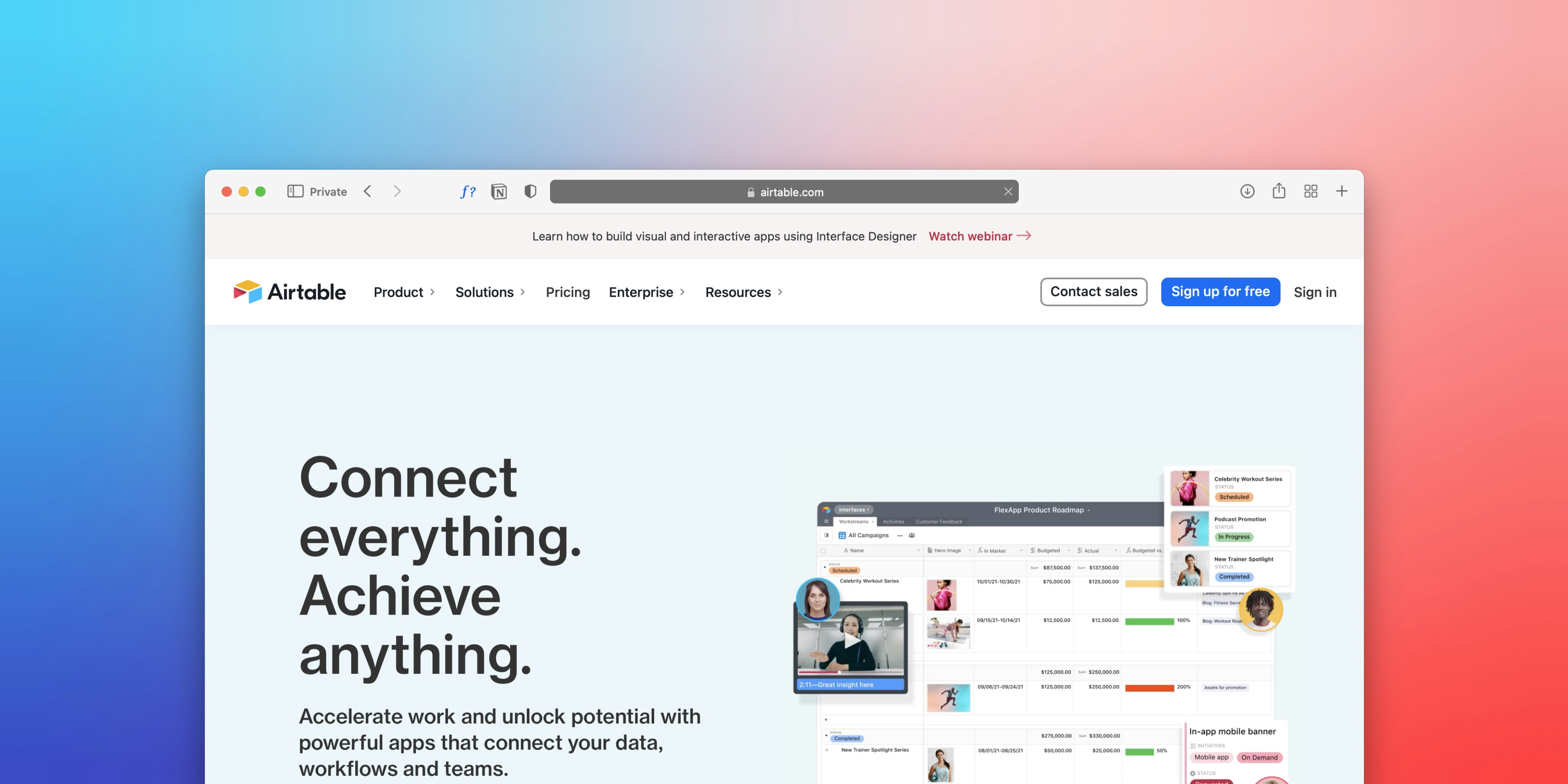
Have you ever tried to manage a big project using a regular spreadsheet, only to find yourself drowning in tabs and confusing columns?
Here’s where Airtable changes how you handle projects. Think of Airtable as the perfect blend of a simple spreadsheet and a powerful database.
It's becoming hugely popular for helping businesses streamline everything, from workflow automation and Airtable for project management to managing crucial business operations.
While Airtable is user-friendly, turning it into a tailor-made system that handles your unique business needs requires expertise. That's why companies hire an Airtable consultant. But who exactly are they, what do they do, and how can they help you make the most of your investment? This guide will break down the role of the Airtable consultant and explain why they might be the key to unlocking your team's efficiency.
Who Is an Airtable Consultant?
An Airtable consultant is a certified expert or specialized agency that helps businesses design, build, optimize, and maintain custom organizational systems using the Airtable platform.
Simply put, they are problem-solvers who take your current, messy workflows like managing clients in multiple spreadsheets or struggling with manual approvals and translate them into a scalable, automated, and efficient system within Airtable. They act as the bridge between your business goals and Airtable's technical capabilities.
What Does an Airtable Consultant Do?
The role of an Airtable consultant is much broader than just setting up a few tables. They serve as a technical advisor and implementation partner, ensuring your Airtable as a database truly works for your unique needs.
Key aspects of an Airtable consultant's role include:
- Workflow Analysis:
They start by assessing a client's existing processes, data sources, and pain points to figure out exactly how Airtable can best be used to solve real problems.
- Custom Database Design:
They structure a scalable and well-organized Airtable base tailored to your business's unique requirements, including creating tables, fields, and crucial linked records.
- Automation Implementation:
They save your team huge amounts of time by automating repetitive tasks and multi-step processes using Airtable's built-in automation features or third-party tools like Zapier or Make (formerly Integromat).
- Integration with Other Tools:
A huge benefit is connecting Airtable with your other essential business software like Google Sheets, Slack, Salesforce, HubSpot to create a unified ecosystem and ensure seamless data flow. These Airtable integrations prevent data silos.
- Custom Scripting and App Development:
When native features aren't enough for complex business problems, they can write custom scripts using JavaScript or build custom interfaces/apps within Airtable to create powerful solutions.
- Data Management and Migration:
They safely assist with migrating your valuable data from legacy systems or old spreadsheets into Airtable, ensuring data integrity and accuracy and cleaning up duplicates.
- Training and Support:
Providing customized training sessions and ongoing support is an important step in empowering your teams to use the new system effectively and confidently.
- Performance Optimization:
They audit and refine existing Airtable setups to enhance speed, improve usability, and make sure the system evolves smoothly with your business's growth.
In essence, an Airtable consultant serves as a technical advisor and implementation partner, turning Airtable into a powerful, tailor-made operational tool that saves time, reduces errors, and helps businesses focus on what they do best.
Why Should You Hire an Airtable Consultant?
Hiring an Airtable consultant is a strategic decision for businesses looking to move beyond basic data management and fully leverage the platform's potential. An expert provides significant value by creating a bespoke, efficient, and scalable system that generic solutions or DIY attempts often fail to achieve.
The following are the primary reasons why you should invest in Airtable consulting services:
1. Tailored Solutions for Unique Workflows
Generic software or standard Airtable templates rarely fit a business's exact, complex needs. An Airtable consultant performs a deep dive into your unique operations to build a custom solution from the ground up.
- Custom Database Design: They structure a true relational database with linked records, custom fields, and Airtable views tailored precisely to your processes, ensuring a single source of truth for all your data.
- Avoid "Spreadsheet Chaos": They prevent a simple base from becoming a cluttered, unmanageable system by applying best practices for architecture and scalability, making your system easy to maintain.
2. Better Efficiency Through Automation
Repetitive, manual tasks consume valuable team time and are highly prone to human error. Consultants identify these bottlenecks and implement powerful Airtable automations.
- Automated Data Entry: Information from web forms, emails, or other platforms can automatically populate your base. For example, they can help you create Airtable forms that automatically log new leads into your CRM.
- Smart Notifications & Updates: Teams receive automated alerts for task assignments, status changes, or low inventory levels, eliminating the need for constant manual checks or endless email chains.
- Workflow Streamlining: Multi-step processes, like client onboarding or order fulfilment, are automated end-to-end, freeing up your team for higher-value, strategic tasks.
3. Seamless Integration with Existing Tools
Businesses use a variety of specialized tools. A consultant expertly connects Airtable with your existing tech stack (e.g., Slack, Google Sheets, Salesforce) to ensure seamless data flow and eliminate information silos.
- Unified Ecosystem: This creates a centralized hub where all your business data is accessible and synchronized in real-time, providing a holistic view of operations. They can help you set up Airtable as a powerful CRM that pulls data from your email platform and your sales tracker.
- Integration Expertise: Consultants know the best tools for the job, whether that's native Airtable integrations or using external automation tools like Zapier or Make.
4. Expert Guidance and Best Practices
Airtable is user-friendly, but its advanced features can be complex. An expert brings deep platform knowledge and experience to the table.
- Scalability: They build systems with future growth in mind, ensuring your Airtable setup scales with your business needs without requiring costly, full rebuilds later on.
- Data Integrity and Security: Consultants implement data validation rules, deduplication processes, and role-based permissions to ensure data accuracy, consistency, and proper security.
5. Time and Cost Savings
Attempting a complex setup internally can be hugely time-consuming and often leads to costly mistakes. Hiring a consultant saves time and money by getting the structure right the first time.
- Faster Implementation: Airtable consultants can design and deploy advanced, custom solutions in days or weeks, as opposed to the months it might take an internal team learning on the fly.
- Reduced Errors: Costly business errors are considerably less likely when validation rules are put in place and manual data entry is minimized.
6. Team Training and Support
A great consultant doesn't just build the system and disappear; they provide tailored training and documentation to ensure your team can confidently use and manage the new setup.
- Higher User Adoption: A system designed with your team's usability in mind and supported by proper training ensures your staff will actually use the new platform, maximizing your return on investment (ROI).
- Ongoing Support: Many Airtable consultants offer ongoing support to quickly troubleshoot issues and adapt the system as your business needs change over time.
Thus, an Airtable consultant helps unlock the platform's full potential, transforming it from a simple data tool into a powerful, customized operational hub that drives efficiency, collaboration, and growth.
When to Hire an Airtable Consultant?
You don’t always need an Airtable consultant right from day one, but there comes a point when managing everything on your own starts to slow you down, becoming counterproductive. If your system is getting messy, your team spends too much time on manual updates, or you feel like Airtable isn't delivering the efficiency it should, that’s your clear cue to bring in an expert.
An Airtable consultant steps in when your business has outgrown simple spreadsheets or when your existing Airtable setup is simply no longer meeting your complex workflow needs. They help you restructure your databases, automate repetitive work, and turn your setup into a scalable system that truly supports your daily operations.
Here are clear signs it’s time to hire an Airtable consulting professional:
- Your Bases Are Getting Complicated: If your Airtable has too many unlinked tables, confusing links, and complicated formulas that are hard to manage, a consultant can simplify your entire structure and make it much more efficient without losing any vital data.
- Your Team Is Struggling to Stay Organized: When different team members use Airtable in different ways, causing confusion, duplicate entries, or missing updates, an Airtable specialist can unify your workflow with a standardized, team-friendly setup perfect for Airtable for project management.
- You’re Spending Hours on Manual Work: Are you still updating records, sending notifications, or generating basic reports by hand? An Airtable expert can automate these low-value tasks so your team focuses on high-value work instead of repetitive admin tasks.
- You Need to Integrate Airtable with Other Tools: If you want Airtable to connect with essential apps like Slack, Google Sheets, HubSpot, or your main CRM, but don’t know how, a consultant can build seamless Airtable integrations using tools like Zapier or custom scripts.
- You’re Scaling or Launching a New Process: When your business expands, new departments, client tiers, or services, your Airtable setup must scale too. An Airtable professional ensures it’s built for long-term growth, not just short-term fixes.
- You Want Better Reporting and Dashboards: If you’re struggling to get clear insights or visualize your data effectively, an Airtable consultant can create custom dashboards and analytics that make tracking performance and making data-driven decisions easy.
- You’re Not Sure If You’re Using Airtable the Right Way: Even if everything "works," hidden inefficiencies might still exist. A consultant can audit your system, find weak points, and suggest improvements to make your setup faster and cleaner.
How an Airtable Consultant Works With You
Hiring an Airtable consultant isn’t just about fixing a few technical issues, it’s about building a partnership that fundamentally transforms how your business operates. A good consultant doesn’t simply "set up" Airtable for you; they learn how your business runs, identify all the current inefficiencies, and design a system that fits seamlessly into your daily workflow.
Here’s a look at what typically happens when you work with an Airtable consultant from start to finish:
1. Discovery & Consultation
The process begins with a detailed discovery call or consultation session. Here, the consultant takes time to understand your big picture business goals, your specific challenges, and the way your team currently manages data and tasks. They’ll ask key questions like: What processes do you want to streamline? What tools do you currently use? What problems are you facing with your existing workflow? This helps them pinpoint the exact areas where Airtable can make the biggest impact.
2. Workflow Mapping & System Design
After clearly understanding your needs, the consultant maps out your processes visually, identifying every input, output, and dependency. Then, they start designing your perfect Airtable structure (bases, tables, views, and relationships). At this stage, they plan exactly how data will flow, which Airtable automations will be set up, and what kind of dashboards or reports you’ll need. Here the goal is to create a clean, logical, and scalable system that precisely mirrors how your business actually operates.
3. Implementation & Setup
Once the structure is finalized, the consultant expertly sets up your Airtable workspace. This may include: Creating custom bases and linked tables, setting up formulas, filters, and views, configuring Airtable automations to save time on repetitive tasks, and integrating third-party tools like Slack, HubSpot, or Google Drive using Zapier, Make, or native Airtable integrations. Everything is built with usability and efficiency in mind, ensuring your team can adopt it quickly and confidently.
4. Testing & Refinement
Before fully rolling out the system, the consultant rigorously tests everything, from formulas to automations, to ensure 100% accuracy and reliability.
- They run real-world scenarios with your data to confirm that the system behaves exactly as expected.
- Any issues are quickly refined and optimized before the final launch.
5. Team Training & Documentation
A crucial part of the process is training your team to use Airtable confidently and correctly. The consultant typically conducts live training sessions and provides clear, step-by-step documentation so your team knows: How to enter and manage data correctly, how to trigger automations, and how to generate reports or dashboards. This ensures that your entire team is aligned and comfortable using the new system.
6. Ongoing Support & Optimization
Even after the initial setup, many Airtable consultants offer ongoing support to monitor performance, fix bugs, and adapt the system as your needs change. They might check in monthly or quarterly to update Airtable integrations, improve automations, or add new features as your operations evolve.
What is the Cost of Hiring an Airtable Consultant?
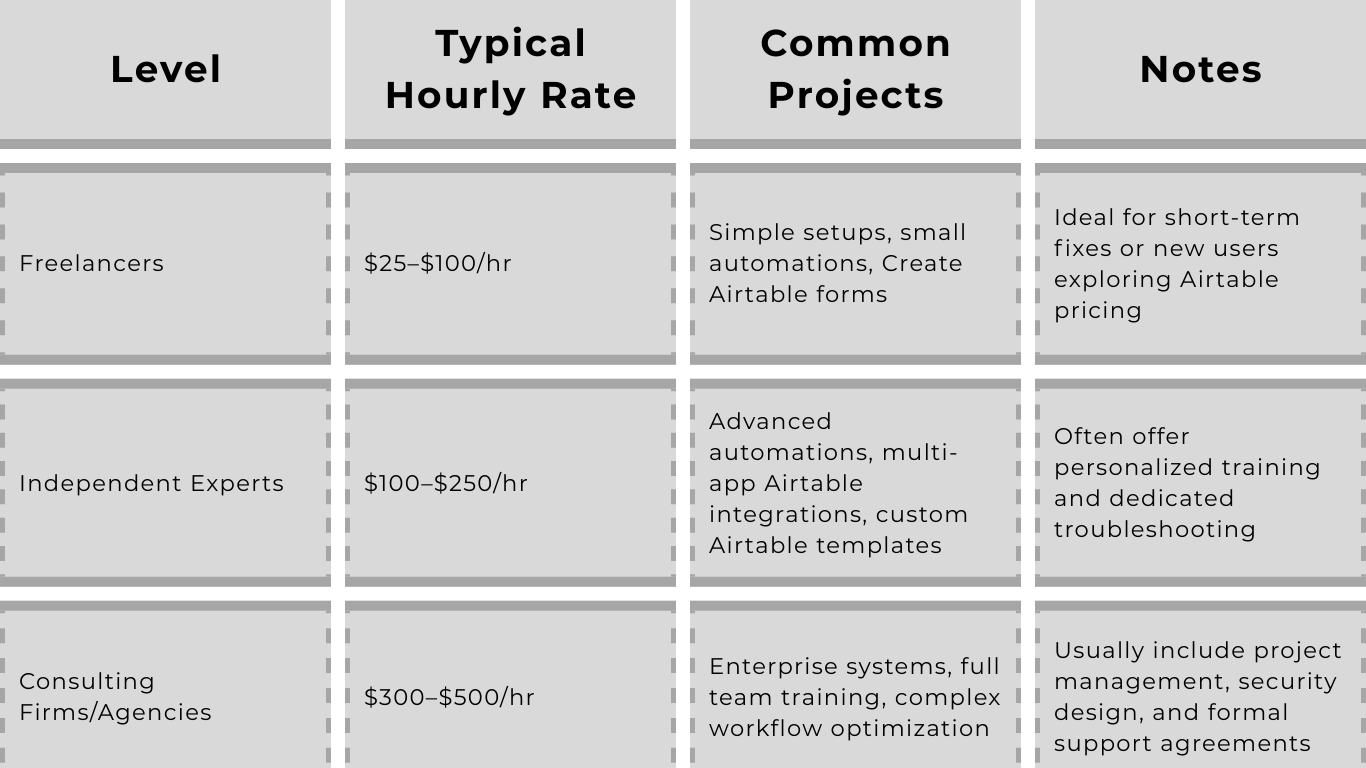
The cost of hiring an Airtable consultant varies significantly depending on the consultant’s expertise, location, and the complexity of your specific project. Generally, pricing falls into three tiers, freelancers, independent experts, and consulting agencies, with rates reflecting both the project scope and the level of technical automation required.
Common Pricing Models
- Hourly Consulting: Most freelancers charge hourly for ad-hoc support, tutorials, or debugging work. Rates typically start at $50/hr for entry-level experts and can exceed $200/hr for specialized automation consultants.
- Project-Based Packages: For complete, defined systems like a custom CRM, content calendar, or inventory dashboard, consultants quote fixed project fees. A typical small business project costs between $1,500–$5,000, while advanced multi-integration systems can range from $10,000–$25,000.
- Retainers or Ongoing Support: Long-term clients pay monthly retainers ($500–$5,000/month) for continuous monitoring, system updates, and staff training.
How to Choose the Right Airtable Consultant?
Choosing the right Airtable consultant can make all the difference between a system that truly transforms your business and one that adds unnecessary complexity. The right consultant will understand both the technical side of Airtable and the operational side of your business, ensuring the final setup fits seamlessly into how your team works.
1. Check Their Experience and Portfolio
Start by reviewing the consultant’s past projects and the types of clients they’ve worked with.
- Have they built Airtable for project management systems for businesses similar to yours?
- Can they share case studies or examples of successful implementations? A consultant who has handled diverse workflows will likely have a strong problem-solving mindset.
2. Look for Technical Expertise
A good Airtable consultant should have deep knowledge of:
- Airtable’s advanced features (linked records, automations, interfaces, and formulas)
- Integration platforms like Zapier, Make (Integromat), or Softr
- Database structuring and advanced workflow design
- API and scripting for complex custom functionality
3. Evaluate Their Understanding of Business Processes
Technical skills alone aren’t enough. The best Airtable consulting experts also understand operations and team workflows.
- They should ask the right questions about how your business runs, from lead tracking and approvals to reporting, and translate those needs into an efficient Airtable structure. Look for someone who listens carefully and proposes practical solutions.
4. Assess Communication and Collaboration Style
A consultant should be easy to work with. They should explain complex technical setups in simple, understandable terms and keep you involved throughout the process. Good communication ensures a smoother project and better final outcomes.
5. Ask About Their Process
Before hiring, ask how they typically work with clients. A structured process should include: Discovery, workflow mapping, system design and setup, testing and feedback, and team training and support. This step-by-step approach shows professionalism and clarity.
What Are the Key Industries That Benefit from Hiring Airtable Consultants?
Every industry across different sectors struggles with managing data, tracking projects, and keeping teams aligned efficiently. This is where an Airtable consultant becomes invaluable. By creating tailored Airtable systems, automating repetitive tasks, and integrating essential tools, consultants help businesses stay organized, save time, and make smarter decisions.
Here are the key industries that benefit the most from hiring Airtable consulting services:
- Marketing and Creative Agencies: Efficiently manage campaigns, content calendars, and client workflows.
- Startups and Tech Companies: Track products, sprints, investor data, and growth metrics.
- E-commerce and Retail: Streamline inventory, orders, and customer data using Airtable as a database.
- Real Estate Firms: Organize property listings, leads, and client communications.
- HR and Recruitment Agencies: Maintain applicant tracking systems and interview workflows.
- Consulting and Professional Services: Track clients, projects, and deliverables efficiently using Airtable for project management.
Conclusion
Investing in an Airtable consultant is much more than just a software purchase; it's an investment in operational efficiency and future growth. An expert ensures you move beyond basic spreadsheets and fully utilize Airtable as a database, creating a customized hub that saves hours every week. This translates directly to reduced costs, fewer errors, and a team focused on strategic success.
Ready to stop wrestling with messy data and start growing your business? Contact us today to schedule a consultation and see how our Airtable consulting services can build the perfect operational system for your team.

FAQ
What services does an Airtable consultant provide?
An Airtable consultant can help you design, build, and optimize Airtable bases for your business. Services often include workflow automation, custom database setup, integrations with other tools (like Slack, Zapier, or Make), reporting dashboards, and team training to ensure your Airtable system runs efficiently.
How can hiring an Airtable consultant benefit my business?
A consultant streamlines your workflows, reduces manual tasks, and improves team collaboration. By organizing data effectively and implementing automations, your team can save time, reduce errors, and focus on higher-value work, ultimately increasing productivity and business efficiency.

Marketing Team
Publisher


Marketing Team
Publisher
Subscribe to Seattle New Media Newsletter

Enter your details to get instant access
Get the File Now
If you'd like to download the file, enter your name and email below, and we'll send it directly to your inbox.
The file has been sent to your email. Please check your inbox!
Have you ever tried to manage a big project using a regular spreadsheet, only to find yourself drowning in tabs and confusing columns?
Here’s where Airtable changes how you handle projects. Think of Airtable as the perfect blend of a simple spreadsheet and a powerful database.
It's becoming hugely popular for helping businesses streamline everything, from workflow automation and Airtable for project management to managing crucial business operations.
While Airtable is user-friendly, turning it into a tailor-made system that handles your unique business needs requires expertise. That's why companies hire an Airtable consultant. But who exactly are they, what do they do, and how can they help you make the most of your investment? This guide will break down the role of the Airtable consultant and explain why they might be the key to unlocking your team's efficiency.
Who Is an Airtable Consultant?
An Airtable consultant is a certified expert or specialized agency that helps businesses design, build, optimize, and maintain custom organizational systems using the Airtable platform.
Simply put, they are problem-solvers who take your current, messy workflows like managing clients in multiple spreadsheets or struggling with manual approvals and translate them into a scalable, automated, and efficient system within Airtable. They act as the bridge between your business goals and Airtable's technical capabilities.
What Does an Airtable Consultant Do?
The role of an Airtable consultant is much broader than just setting up a few tables. They serve as a technical advisor and implementation partner, ensuring your Airtable as a database truly works for your unique needs.
Key aspects of an Airtable consultant's role include:
- Workflow Analysis:
They start by assessing a client's existing processes, data sources, and pain points to figure out exactly how Airtable can best be used to solve real problems.
- Custom Database Design:
They structure a scalable and well-organized Airtable base tailored to your business's unique requirements, including creating tables, fields, and crucial linked records.
- Automation Implementation:
They save your team huge amounts of time by automating repetitive tasks and multi-step processes using Airtable's built-in automation features or third-party tools like Zapier or Make (formerly Integromat).
- Integration with Other Tools:
A huge benefit is connecting Airtable with your other essential business software like Google Sheets, Slack, Salesforce, HubSpot to create a unified ecosystem and ensure seamless data flow. These Airtable integrations prevent data silos.
- Custom Scripting and App Development:
When native features aren't enough for complex business problems, they can write custom scripts using JavaScript or build custom interfaces/apps within Airtable to create powerful solutions.
- Data Management and Migration:
They safely assist with migrating your valuable data from legacy systems or old spreadsheets into Airtable, ensuring data integrity and accuracy and cleaning up duplicates.
- Training and Support:
Providing customized training sessions and ongoing support is an important step in empowering your teams to use the new system effectively and confidently.
- Performance Optimization:
They audit and refine existing Airtable setups to enhance speed, improve usability, and make sure the system evolves smoothly with your business's growth.
In essence, an Airtable consultant serves as a technical advisor and implementation partner, turning Airtable into a powerful, tailor-made operational tool that saves time, reduces errors, and helps businesses focus on what they do best.
Why Should You Hire an Airtable Consultant?
Hiring an Airtable consultant is a strategic decision for businesses looking to move beyond basic data management and fully leverage the platform's potential. An expert provides significant value by creating a bespoke, efficient, and scalable system that generic solutions or DIY attempts often fail to achieve.
The following are the primary reasons why you should invest in Airtable consulting services:
1. Tailored Solutions for Unique Workflows
Generic software or standard Airtable templates rarely fit a business's exact, complex needs. An Airtable consultant performs a deep dive into your unique operations to build a custom solution from the ground up.
- Custom Database Design: They structure a true relational database with linked records, custom fields, and Airtable views tailored precisely to your processes, ensuring a single source of truth for all your data.
- Avoid "Spreadsheet Chaos": They prevent a simple base from becoming a cluttered, unmanageable system by applying best practices for architecture and scalability, making your system easy to maintain.
2. Better Efficiency Through Automation
Repetitive, manual tasks consume valuable team time and are highly prone to human error. Consultants identify these bottlenecks and implement powerful Airtable automations.
- Automated Data Entry: Information from web forms, emails, or other platforms can automatically populate your base. For example, they can help you create Airtable forms that automatically log new leads into your CRM.
- Smart Notifications & Updates: Teams receive automated alerts for task assignments, status changes, or low inventory levels, eliminating the need for constant manual checks or endless email chains.
- Workflow Streamlining: Multi-step processes, like client onboarding or order fulfilment, are automated end-to-end, freeing up your team for higher-value, strategic tasks.
3. Seamless Integration with Existing Tools
Businesses use a variety of specialized tools. A consultant expertly connects Airtable with your existing tech stack (e.g., Slack, Google Sheets, Salesforce) to ensure seamless data flow and eliminate information silos.
- Unified Ecosystem: This creates a centralized hub where all your business data is accessible and synchronized in real-time, providing a holistic view of operations. They can help you set up Airtable as a powerful CRM that pulls data from your email platform and your sales tracker.
- Integration Expertise: Consultants know the best tools for the job, whether that's native Airtable integrations or using external automation tools like Zapier or Make.
4. Expert Guidance and Best Practices
Airtable is user-friendly, but its advanced features can be complex. An expert brings deep platform knowledge and experience to the table.
- Scalability: They build systems with future growth in mind, ensuring your Airtable setup scales with your business needs without requiring costly, full rebuilds later on.
- Data Integrity and Security: Consultants implement data validation rules, deduplication processes, and role-based permissions to ensure data accuracy, consistency, and proper security.
5. Time and Cost Savings
Attempting a complex setup internally can be hugely time-consuming and often leads to costly mistakes. Hiring a consultant saves time and money by getting the structure right the first time.
- Faster Implementation: Airtable consultants can design and deploy advanced, custom solutions in days or weeks, as opposed to the months it might take an internal team learning on the fly.
- Reduced Errors: Costly business errors are considerably less likely when validation rules are put in place and manual data entry is minimized.
6. Team Training and Support
A great consultant doesn't just build the system and disappear; they provide tailored training and documentation to ensure your team can confidently use and manage the new setup.
- Higher User Adoption: A system designed with your team's usability in mind and supported by proper training ensures your staff will actually use the new platform, maximizing your return on investment (ROI).
- Ongoing Support: Many Airtable consultants offer ongoing support to quickly troubleshoot issues and adapt the system as your business needs change over time.
Thus, an Airtable consultant helps unlock the platform's full potential, transforming it from a simple data tool into a powerful, customized operational hub that drives efficiency, collaboration, and growth.
When to Hire an Airtable Consultant?
You don’t always need an Airtable consultant right from day one, but there comes a point when managing everything on your own starts to slow you down, becoming counterproductive. If your system is getting messy, your team spends too much time on manual updates, or you feel like Airtable isn't delivering the efficiency it should, that’s your clear cue to bring in an expert.
An Airtable consultant steps in when your business has outgrown simple spreadsheets or when your existing Airtable setup is simply no longer meeting your complex workflow needs. They help you restructure your databases, automate repetitive work, and turn your setup into a scalable system that truly supports your daily operations.
Here are clear signs it’s time to hire an Airtable consulting professional:
- Your Bases Are Getting Complicated: If your Airtable has too many unlinked tables, confusing links, and complicated formulas that are hard to manage, a consultant can simplify your entire structure and make it much more efficient without losing any vital data.
- Your Team Is Struggling to Stay Organized: When different team members use Airtable in different ways, causing confusion, duplicate entries, or missing updates, an Airtable specialist can unify your workflow with a standardized, team-friendly setup perfect for Airtable for project management.
- You’re Spending Hours on Manual Work: Are you still updating records, sending notifications, or generating basic reports by hand? An Airtable expert can automate these low-value tasks so your team focuses on high-value work instead of repetitive admin tasks.
- You Need to Integrate Airtable with Other Tools: If you want Airtable to connect with essential apps like Slack, Google Sheets, HubSpot, or your main CRM, but don’t know how, a consultant can build seamless Airtable integrations using tools like Zapier or custom scripts.
- You’re Scaling or Launching a New Process: When your business expands, new departments, client tiers, or services, your Airtable setup must scale too. An Airtable professional ensures it’s built for long-term growth, not just short-term fixes.
- You Want Better Reporting and Dashboards: If you’re struggling to get clear insights or visualize your data effectively, an Airtable consultant can create custom dashboards and analytics that make tracking performance and making data-driven decisions easy.
- You’re Not Sure If You’re Using Airtable the Right Way: Even if everything "works," hidden inefficiencies might still exist. A consultant can audit your system, find weak points, and suggest improvements to make your setup faster and cleaner.
How an Airtable Consultant Works With You
Hiring an Airtable consultant isn’t just about fixing a few technical issues, it’s about building a partnership that fundamentally transforms how your business operates. A good consultant doesn’t simply "set up" Airtable for you; they learn how your business runs, identify all the current inefficiencies, and design a system that fits seamlessly into your daily workflow.
Here’s a look at what typically happens when you work with an Airtable consultant from start to finish:
1. Discovery & Consultation
The process begins with a detailed discovery call or consultation session. Here, the consultant takes time to understand your big picture business goals, your specific challenges, and the way your team currently manages data and tasks. They’ll ask key questions like: What processes do you want to streamline? What tools do you currently use? What problems are you facing with your existing workflow? This helps them pinpoint the exact areas where Airtable can make the biggest impact.
2. Workflow Mapping & System Design
After clearly understanding your needs, the consultant maps out your processes visually, identifying every input, output, and dependency. Then, they start designing your perfect Airtable structure (bases, tables, views, and relationships). At this stage, they plan exactly how data will flow, which Airtable automations will be set up, and what kind of dashboards or reports you’ll need. Here the goal is to create a clean, logical, and scalable system that precisely mirrors how your business actually operates.
3. Implementation & Setup
Once the structure is finalized, the consultant expertly sets up your Airtable workspace. This may include: Creating custom bases and linked tables, setting up formulas, filters, and views, configuring Airtable automations to save time on repetitive tasks, and integrating third-party tools like Slack, HubSpot, or Google Drive using Zapier, Make, or native Airtable integrations. Everything is built with usability and efficiency in mind, ensuring your team can adopt it quickly and confidently.
4. Testing & Refinement
Before fully rolling out the system, the consultant rigorously tests everything, from formulas to automations, to ensure 100% accuracy and reliability.
- They run real-world scenarios with your data to confirm that the system behaves exactly as expected.
- Any issues are quickly refined and optimized before the final launch.
5. Team Training & Documentation
A crucial part of the process is training your team to use Airtable confidently and correctly. The consultant typically conducts live training sessions and provides clear, step-by-step documentation so your team knows: How to enter and manage data correctly, how to trigger automations, and how to generate reports or dashboards. This ensures that your entire team is aligned and comfortable using the new system.
6. Ongoing Support & Optimization
Even after the initial setup, many Airtable consultants offer ongoing support to monitor performance, fix bugs, and adapt the system as your needs change. They might check in monthly or quarterly to update Airtable integrations, improve automations, or add new features as your operations evolve.
What is the Cost of Hiring an Airtable Consultant?
The cost of hiring an Airtable consultant varies significantly depending on the consultant’s expertise, location, and the complexity of your specific project. Generally, pricing falls into three tiers, freelancers, independent experts, and consulting agencies, with rates reflecting both the project scope and the level of technical automation required.
Common Pricing Models
- Hourly Consulting: Most freelancers charge hourly for ad-hoc support, tutorials, or debugging work. Rates typically start at $50/hr for entry-level experts and can exceed $200/hr for specialized automation consultants.
- Project-Based Packages: For complete, defined systems like a custom CRM, content calendar, or inventory dashboard, consultants quote fixed project fees. A typical small business project costs between $1,500–$5,000, while advanced multi-integration systems can range from $10,000–$25,000.
- Retainers or Ongoing Support: Long-term clients pay monthly retainers ($500–$5,000/month) for continuous monitoring, system updates, and staff training.
How to Choose the Right Airtable Consultant?
Choosing the right Airtable consultant can make all the difference between a system that truly transforms your business and one that adds unnecessary complexity. The right consultant will understand both the technical side of Airtable and the operational side of your business, ensuring the final setup fits seamlessly into how your team works.
1. Check Their Experience and Portfolio
Start by reviewing the consultant’s past projects and the types of clients they’ve worked with.
- Have they built Airtable for project management systems for businesses similar to yours?
- Can they share case studies or examples of successful implementations? A consultant who has handled diverse workflows will likely have a strong problem-solving mindset.
2. Look for Technical Expertise
A good Airtable consultant should have deep knowledge of:
- Airtable’s advanced features (linked records, automations, interfaces, and formulas)
- Integration platforms like Zapier, Make (Integromat), or Softr
- Database structuring and advanced workflow design
- API and scripting for complex custom functionality
3. Evaluate Their Understanding of Business Processes
Technical skills alone aren’t enough. The best Airtable consulting experts also understand operations and team workflows.
- They should ask the right questions about how your business runs, from lead tracking and approvals to reporting, and translate those needs into an efficient Airtable structure. Look for someone who listens carefully and proposes practical solutions.
4. Assess Communication and Collaboration Style
A consultant should be easy to work with. They should explain complex technical setups in simple, understandable terms and keep you involved throughout the process. Good communication ensures a smoother project and better final outcomes.
5. Ask About Their Process
Before hiring, ask how they typically work with clients. A structured process should include: Discovery, workflow mapping, system design and setup, testing and feedback, and team training and support. This step-by-step approach shows professionalism and clarity.
What Are the Key Industries That Benefit from Hiring Airtable Consultants?
Every industry across different sectors struggles with managing data, tracking projects, and keeping teams aligned efficiently. This is where an Airtable consultant becomes invaluable. By creating tailored Airtable systems, automating repetitive tasks, and integrating essential tools, consultants help businesses stay organized, save time, and make smarter decisions.
Here are the key industries that benefit the most from hiring Airtable consulting services:
- Marketing and Creative Agencies: Efficiently manage campaigns, content calendars, and client workflows.
- Startups and Tech Companies: Track products, sprints, investor data, and growth metrics.
- E-commerce and Retail: Streamline inventory, orders, and customer data using Airtable as a database.
- Real Estate Firms: Organize property listings, leads, and client communications.
- HR and Recruitment Agencies: Maintain applicant tracking systems and interview workflows.
- Consulting and Professional Services: Track clients, projects, and deliverables efficiently using Airtable for project management.
Conclusion
Investing in an Airtable consultant is much more than just a software purchase; it's an investment in operational efficiency and future growth. An expert ensures you move beyond basic spreadsheets and fully utilize Airtable as a database, creating a customized hub that saves hours every week. This translates directly to reduced costs, fewer errors, and a team focused on strategic success.
Ready to stop wrestling with messy data and start growing your business? Contact us today to schedule a consultation and see how our Airtable consulting services can build the perfect operational system for your team.
FAQ
What services does an Airtable consultant provide?
An Airtable consultant can help you design, build, and optimize Airtable bases for your business. Services often include workflow automation, custom database setup, integrations with other tools (like Slack, Zapier, or Make), reporting dashboards, and team training to ensure your Airtable system runs efficiently.
How can hiring an Airtable consultant benefit my business?
A consultant streamlines your workflows, reduces manual tasks, and improves team collaboration. By organizing data effectively and implementing automations, your team can save time, reduce errors, and focus on higher-value work, ultimately increasing productivity and business efficiency.
Marketing Team
Publisher
Subscribe to Seattle New Media Newsletter
Marketing Team
Publisher
Get the File Now
If you'd like to download the file, enter your name and email below, and we'll send it directly to your inbox.
The file has been sent to your email. Please check your inbox!
.png)


Hi, I'm Mike!
If you are enjoying the article, feel free to subscribe to our monthly newsletter.
If you have any project requirements, please contact us.


