
-p-2000.png)


E-Commerce's Future: How Webflow Helps Online Stores
.webp)
Let us not mince words here: the e-commerce landscape in 2026 is a war zone. It is a full-contact, no-holds-barred, intensely competitive digital battlefield where millions of brands are locked in a daily struggle for the attention, the loyalty, and, most importantly, the wallets of the American consumer.
According to market data, United States e-commerce sales have crossed the one-trillion dollar threshold. That is not a typo. One trillion dollars. And yet, amidst all that explosive growth, the majority of online store owners are still building their digital storefronts on platforms that were designed for a world that no longer exists.
Here is the hard truth that most platform vendors will not tell you: your website is the single most important salesperson you have ever hired. It works around the clock, never calls in sick, does not demand a commission, and represents your brand to every potential customer who encounters it, regardless of whether it is 3 o'clock in the afternoon in Manhattan or 2 o'clock in the morning in Minneapolis. If your website is generic, slow, hard to navigate, or looks like it was assembled from the same cookie-cutter template your competitor used, you are not just leaving money on the table, you are actively handing that money to your competition.
This is precisely why a growing and substantial number of savvy American marketers, forward-thinking brand builders, and growth-obsessed entrepreneurs are turning their attention to Webflow as their e-commerce platform of choice. Not because it is the flashiest new toy in the sandbox, but because it solves the fundamental problem that has plagued digital commerce since its inception: the tension between design freedom and technical accessibility. Today, in this comprehensive and thoroughly detailed examination, we are going to explore exactly what that means, why it matters, and how Webflow stacks up against every major competitor worth discussing in the current marketplace.
"The web is the world's most saturated marketplace. If your online store looks like everyone else's, you have already lost half the battle before the customer even sees your product." A maxim every serious e-commerce marketer ought to have tattooed on the inside of their eyelids.
Understanding the E-Commerce Landscape, Where We Are and Where We Are Headed
The Explosive Growth Nobody Should Be Surprised By
If you have been paying even a modicum of attention to the world of digital business over the past decade, the explosive growth of e-commerce should come as absolutely no surprise to you whatsoever. The pandemic years accelerated a trend that was already well underway, catapulting consumers into digital commerce with a velocity that fundamentally and permanently altered shopping behavior across every demographic, every geographic region, and every product category imaginable.
The data is unambiguous: mobile commerce now accounts for the majority of e-commerce traffic. Voice search, powered by devices like Amazon Alexa, Google Home, and Apple Siri, is reshaping how consumers discover and purchase products. Artificial intelligence is transforming product recommendations, customer service, and even inventory management, while tools like an AI video generator are enabling brands to create engaging visual content at scale. The question for every brand operating an online store is no longer whether to take digital commerce seriously, that debate is long over, but rather how to build a digital presence worthy of the enormously discerning and fickle modern consumer.
The Three Cardinal Sins of Modern E-Commerce Websites
Before we can understand why Webflow represents a genuinely compelling solution for the future of online retail, we must first understand the problems it is solving. In our extensive analysis of the competitive landscape, three cardinal sins emerge repeatedly as the primary causes of underperforming e-commerce stores in the United States today:
- Generic Template Syndrome: The overwhelming majority of online stores built on traditional e-commerce platforms look disturbingly, almost embarrassingly similar to one another. When you and your direct competitor are both running the same Shopify theme, perhaps with different colors applied, you have surrendered your most powerful branding opportunity before the customer even begins to evaluate your product. Design differentiation is not a luxury in modern e-commerce. It is a competitive necessity.
- Performance Neglect: Google's Core Web Vitals initiative was not a suggestion, people. It was a declaration. Page load speed, visual stability, and interactivity are now ranking factors, full stop. Slow websites do not just frustrate users; they are actively penalized by search algorithms, meaning they receive less organic traffic, which means fewer potential customers, which means lower revenue. The cycle is vicious and entirely avoidable.
- SEO Architecture Failure: Many e-commerce platforms generate bloated, difficult-to-crawl code that actively works against your search engine optimization efforts. When Google's crawlers cannot efficiently index your product pages, your category pages, and your content, you are fighting an uphill SEO battle with both hands tied behind your back.
What Exactly Is Webflow, and Why Should Every Serious Marketer Care?
Webflow is, at its core, a visual web development and content management platform that allows designers, marketers, and entrepreneurs to build professional-grade websites and e-commerce stores without writing traditional code, while simultaneously generating genuinely clean, semantic HTML, CSS, and JavaScript under the hood. That last part is critically important, and we will return to it repeatedly throughout this discussion.
Founded in 2013 and headquartered in San Francisco, California, Webflow has grown from a niche tool favored by design purists into a platform trusted by over three million designers and teams worldwide. The platform has, in recent years, made substantial and serious investments in its e-commerce capabilities, positioning itself explicitly as a direct competitor to platforms like Shopify, Wix, BigCommerce, and Squarespace for brands that refuse to compromise on design quality, technical performance, or marketing flexibility.
What makes Webflow genuinely different from every other platform is its entire product design, that the limitations imposed by traditional website builders and e-commerce platforms are artificial constraints that serve the platform's technical simplicity at the expense of the user's creative and commercial potential. Webflow's proposition is elegantly simple, giving serious creative professionals and business owners the full power of the web, without requiring them to write a single line of code if they choose not to.
Key Insight for Marketers: Webflow reports that 8% of its new signups now come directly from AI search traffic, a remarkable and telling statistic that speaks to the platform's growing visibility in an era when AI tools like ChatGPT and Google's AI Overviews are reshaping how consumers discover tools and services online.
Webflow's Core E-Commerce Capabilities, A Feature-by-Feature Breakdown
Let us be specific and granular here, because generalities do not serve serious business people. Here is what Webflow's e-commerce functionality actually delivers in concrete, operational terms:
- Visual, Code-Free Store Design: Every aspect of your store's visual presentation, from the product listing pages to the individual product detail pages, to the shopping cart interface, to the checkout experience itself, is fully customizable within Webflow's visual editor. This is not template customization. This is ground-up visual design with the full power of CSS and HTML available to you, expressed through a drag-and-drop interface that requires no coding knowledge.
- Fully Customizable Checkout: Unlike Shopify, which restricts checkout customization to users on its most expensive Plus tier (at $2,300 per month, no less), Webflow allows checkout customization on all its e-commerce plans. For growing brands obsessed with conversion rate optimization, this is not a minor detail. The checkout experience is where sales are won or lost, and the ability to brand and optimize that experience at every price point is a meaningful competitive advantage.
- Integrated CMS for Content Marketing: Webflow's Content Management System is universally regarded as one of the most powerful and flexible CMS offerings available on any website builder platform. For e-commerce brands, and every serious e-commerce brand in 2026 had better be a content marketing brand, this means the same system powering your product database can power your blog, your case studies, your lookbooks, and your editorial content. No fragmented tools, no awkward integrations, no data silos.
- Dynamic SEO Controls: Webflow allows users to dynamically generate SEO-friendly title tags, meta descriptions, H1 headers, and URL structures from CMS field data. This means that as you add products, categories, and content to your store, SEO-optimized page metadata is generated automatically according to your specifications. For a platform built for marketers, this is the kind of operational efficiency that pays dividends for years.
- Clean Semantic Code Generation: Every website and store built in Webflow exports and publishes clean, standards-compliant HTML, CSS, and JavaScript. For technical SEO practitioners and developers who need to extend platform functionality with custom code, this is a critically important foundation.
- E-Commerce Pricing Tiers: Webflow's Standard e-commerce plan begins at $29 per month (billed annually), includes up to 500 e-commerce items, 2,000 CMS items, customizable checkout, shopping cart, and email templates, a genuinely competitive entry price point for small-to-medium brands. The Plus plan at $74 per month and the Advanced plan at $212 per month provide increasing capacity, with the Advanced tier offering up to 15,000 e-commerce items, no transaction fees, and uncapped annual sales volume.
You may be interested in reading our blog on Webflow Ecommerce: Scale Your Online Store with No Code.
The Competitor Comparison, Webflow vs. The Full Competitive Landscape
Any competent marketer worth their salary conducts thorough competitive analysis before making a platform decision of this magnitude. We have done that work for you. What follows is an honest, balanced, and analytically rigorous comparison of Webflow against every major e-commerce platform currently competing for American market share. We are going to call it like we see it, advantages, disadvantages, and everything in between.
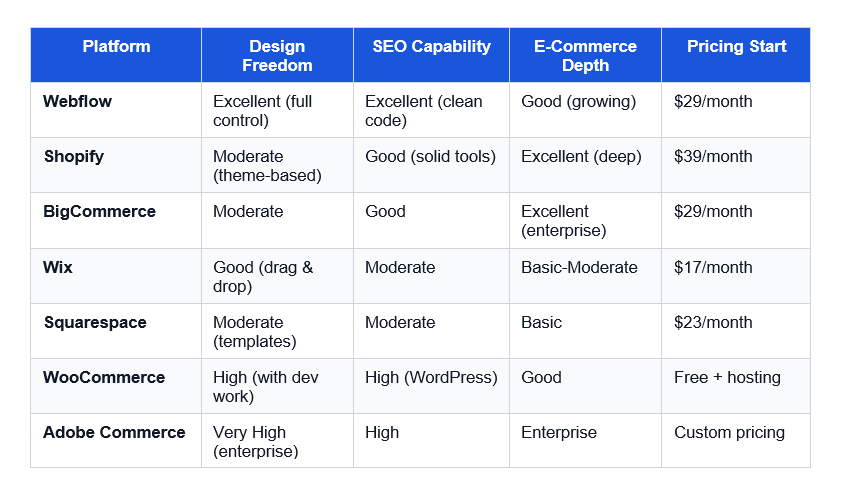
Webflow vs. Shopify: The Central Battle for Design-Forward E-Commerce
Shopify is, without question, the most popular e-commerce platform on the planet today. It is trusted by brands ranging from small independent boutiques to massive enterprise retailers. Shopify's strengths are real, documented, and not to be dismissed: an extensive app marketplace, robust inventory management, mature abandoned cart recovery tools available on all plans, and an ecosystem of third-party integrations that is genuinely unmatched in the industry.
However, and this is substantial however, Shopify's fundamental approach to website design is template-based. When you build a Shopify store, you select a theme, and that theme defines the structural limits of your store's visual presentation. Shopify's own competitive landing page states it plainly: 'Shopify templates are beautiful, no doubt. As long as you're okay with your store looking just like your competitor's.' The customization available beyond theme parameters requires working in Shopify's proprietary Liquid template language, which introduces a significant technical barrier for non-developer marketers.
Webflow, by direct contrast, provides what reviewers and industry analysts consistently describe as genuinely superior design freedom. Every element of a Webflow store can be positioned, styled, animated, and arranged according to the designer's exact intentions, without template constraints and without proprietary scripting languages. For brands where visual identity and user experience are primary competitive differentiators, luxury goods, premium lifestyle brands, high-fashion retail, artisan products, Webflow's design capabilities are arguably unmatched in the no-code space.
Where Shopify maintains a clear and undisputed advantage is in its depth of native e-commerce functionality. Shopify was built as an e-commerce platform from day one; its inventory management, fulfillment integrations, multi-channel selling capabilities (including TikTok Shop, Pinterest, Etsy, and Amazon), and its Point of Sale system are all mature, robust, and deeply integrated into the platform's core. Webflow's e-commerce functionality, while improving steadily, supports a maximum of 50 product variants per product, compared to Shopify's expanded support for up to 2,048 variants as of 2025. For brands selling complex, highly configurable products, this distinction matters enormously.
The bottom line on Shopify vs. Webflow: If your primary competitive advantage is your brand's visual identity and user experience, and your product catalog is relatively streamlined, Webflow offers a compelling combination of design excellence and strong SEO capabilities. If you are running a high-volume store with complex inventory requirements, extensive app integrations, or multi-channel selling ambitions, Shopify remains the more operationally mature choice.
Webflow vs. BigCommerce: The Enterprise E-Commerce Challenger
BigCommerce occupies an interesting and specific niche in the e-commerce platform landscape: it is explicitly targeting enterprise-level companies and mid-market retailers who require sophisticated e-commerce functionality at what it presents as a competitive price point relative to Shopify. BigCommerce's strengths include integration with over 65 payment providers, support for more than 140 currencies, native tools for international selling, phone and live chat support on all plans, and integration with major sales channels including Google Shopping, Facebook, Amazon, and Etsy.
However, BigCommerce's Achilles heel has always been design flexibility. Its theme selection is more limited than Shopify's, the platform offers fewer free themes than its competitors, and its website design customization capabilities are widely regarded as less flexible than both Shopify and Webflow. For brands whose competitive differentiation is rooted in superior digital experience design, BigCommerce's design constraints are a meaningful limitation.
Additionally, BigCommerce uses a revenue-based tier upgrade system that automatically moves merchants to higher (and more expensive) plan tiers when their annual sales exceed certain thresholds. This pricing model creates uncertainty in budget planning for growing brands and has been cited as a source of frustration among merchants experiencing rapid growth.
Webflow vs. Wix: When Simplicity Has Its Limits
Wix is the platform most often recommended to absolute beginners entering the world of website building, and for understandable reasons. Its drag-and-drop interface is genuinely intuitive, its pricing is accessible, and its template library is large and visually appealing. However, Wix's e-commerce functionality has consistently been identified by analysts and practitioners as one of its most significant weaknesses. Wix lacks robust native inventory management tools, its multi-channel selling capabilities are limited primarily to Facebook and Instagram (accessible through the third-party Ecwid integration), and its e-commerce features are widely regarded as insufficient for product-based businesses with serious scaling ambitions.
Furthermore, Wix's approach to website construction, while beginner-friendly, can actually work against SEO efforts. Wix generates substantially heavier code than Webflow and has historically been criticized by SEO practitioners for technical issues that complicate search engine indexing and crawling. For any e-commerce brand that is serious about organic search as a traffic acquisition channel, these technical concerns deserve careful consideration.
Webflow vs. Squarespace: The Portfolio Platform Pretending to Be an E-Commerce Solution
Squarespace is an aesthetically exceptional platform for portfolio websites, creative agency presentations, and service-based businesses. Its templates are legitimately beautiful, its visual design sensibility is impeccable, and its interface is among the most polished in the website builder market. What Squarespace is decidedly not, however, is a serious e-commerce platform for growth-oriented retail brands.
Squarespace's e-commerce functionality has been described, quite fairly, as basic e-commerce capabilities bolted onto a design-first platform. The platform lacks the depth of inventory management, the marketing tool integrations, the multi-channel selling capabilities, and the scalability that serious e-commerce operations require. For a boutique with ten to twenty products and modest sales ambitions, Squarespace may be perfectly adequate. For any brand with genuine growth ambitions, it is likely to become a limiting constraint faster than anticipated.
Webflow vs. WooCommerce and Adobe Commerce: The Open-Source Heavy Hitters
WooCommerce, the WordPress-based e-commerce plugin, and Adobe Commerce (formerly Magento) represent a fundamentally different approach to online retail: open-source platforms that offer extraordinary flexibility and customization capabilities, but that require substantial technical expertise and development resources to implement and maintain effectively.
WooCommerce benefits enormously from the massive WordPress plugin ecosystem, the same ecosystem that makes WordPress the world's most widely used content management system. Its SEO capabilities, powered by plugins like Yoast SEO and Rank Math, are robust and mature. Its customization potential is essentially unlimited, provided you have the development resources to exploit it. However, WooCommerce's operational overhead, server maintenance, security updates, plugin compatibility management, performance optimization, is substantially higher than any hosted platform.
Adobe Commerce is positioned for large enterprise retailers. Companies like Adidas and Lacoste have deployed it for their e-commerce operations. However, the total cost of ownership for Adobe Commerce, which requires significant in-house development resources, extensive implementation investment, and ongoing technical maintenance, has been reported to be as much as five times higher than comparable Shopify implementations. For the vast majority of American businesses, this equation simply does not make financial sense.
Why Webflow Wins the Search Engine Battle
Let us have a direct and unvarnished conversation about search engine optimization, because there is no marketing channel more important to long-term e-commerce success, and no area where platform choice has a more profound and lasting impact, than organic search.
Paid advertising is extraordinarily expensive in 2026. Cost-per-click rates across Google, Meta, and TikTok have increased substantially year over year as competition for digital advertising inventory intensifies. The brands that will win the long game in American e-commerce are those that build durable, compounding organic traffic through genuinely excellent SEO practices. And genuinely excellent SEO practices begin with a platform that is built to support them.
Clean Code Architecture: The SEO Foundation That Most Platforms Get Wrong
Here is something that many e-commerce platform marketing departments would prefer you did not think too hard about: the quality of the underlying code that your website builder generates has a direct and measurable impact on how efficiently search engine crawlers can index your pages, how quickly those pages load for end users, and therefore how well those pages rank in organic search results.
Webflow generates clean, semantic HTML5, CSS3, and JavaScript that adheres to web standards. This is not marketing language, it is a technical reality that has been documented repeatedly by SEO practitioners who have analyzed the code output of major website builders. Clean code means faster page loads. Faster page loads mean better Google Core Web Vitals scores. Better Core Web Vitals scores are a confirmed ranking signal. The chain of causation is clear and well-established.
Core Web Vitals and Technical SEO: Where the Rubber Meets the Road
Google's Core Web Vitals initiative, measuring Largest Contentful Paint (LCP), Cumulative Layout Shift (CLS), and First Input Delay (FID), has become a cornerstone of technical SEO practice. These metrics do not just influence search rankings; they directly affect conversion rates. Research consistently demonstrates that faster-loading pages convert at higher rates, that stable visual experiences reduce bounce rates, and that responsive interactive elements improve user engagement metrics.
Webflow's hosting infrastructure, built on Amazon Web Services and leveraging Fastly's global Content Delivery Network, delivers page load performance that consistently meets or exceeds Core Web Vitals benchmarks. For e-commerce marketers who understand that every millisecond of page load time represents measurable revenue impact, this infrastructure quality is not a minor consideration.
Dynamic SEO Automation: Scale Your SEO Without Scaling Your Workload
One of the most genuinely impressive and practically valuable features in Webflow's SEO toolkit is its ability to dynamically generate SEO metadata, title tags, meta descriptions, canonical URLs, Open Graph tags, structured data markup, from CMS Collection fields. This means that as your product catalog grows, your category pages multiply, and your editorial content expands, your SEO metadata scales automatically according to templates you define once.
For an e-commerce store with hundreds or thousands of SKUs, manually writing SEO-optimized title tags and meta descriptions for every product page is an enormously time-consuming task. Webflow's dynamic SEO automation transforms this from a recurring operational burden into a one-time template configuration exercise. The compounding time savings over the lifetime of a growing e-commerce operation are substantial.
2026 E-Commerce SEO Trends That Webflow Is Built to Exploit
The SEO landscape for e-commerce in 2026 is being shaped by several converging trends that have profound implications for platform selection. Here is how those trends intersect with Webflow's specific capabilities:
- Voice Search Optimization: Research indicates that 81% of Americans now use voice assistants in everyday tasks, and approximately 29% use voice devices for shopping. Voice search queries are characteristically conversational, long-tail, and question-based. Webflow's flexible CMS makes it straightforward to build FAQ sections, conversational content pages, and Q&A structured data implementations that target voice search traffic, critical for any e-commerce brand with ambitions in this rapidly growing channel.
- AI-Powered Search Traffic: Webflow has publicly reported that 8% of its new signups now arrive via AI search traffic, a remarkable data point indicating that the platform's content and brand presence is being surfaced by AI tools like ChatGPT, Google's AI Overviews, and Perplexity. For e-commerce brands, this trend underscores the importance of building genuinely informative, well-structured content that AI systems recognize as authoritative and trustworthy.
- E-E-A-T Signals: Google's Experience, Expertise, Authoritativeness, and Trustworthiness framework has become a central organizing principle for content quality evaluation. Webflow's powerful CMS, enabling brands to build editorial blogs, expert guides, product reviews, video content, and case studies, provides the structural foundation for building strong E-E-A-T signals across an e-commerce website.
- Mobile-First Indexing: Google now indexes the mobile versions of websites first and uses those mobile versions as the primary basis for ranking determinations. Webflow's visual design environment includes native responsive design tools that make building genuinely excellent mobile experiences, not just adequate ones, significantly more accessible than platforms that treat mobile optimization as an afterthought.
- Structured Data Implementation: Schema markup, the structured data vocabulary that helps search engines understand and represent your content in rich search result formats, is increasingly critical for e-commerce SEO visibility. Webflow supports custom code embedding that enables sophisticated structured data implementations, including Product schema, Review schema, BreadcrumbList schema, and FAQ schema that directly support rich snippet eligibility in search results.
Content Marketing and the Webflow CMS: Your Unfair Competitive Advantage
Here is a truth that many e-commerce platform vendors do not want you to internalize, because it reveals a fundamental weakness in their offering: the platforms that will win the e-commerce marketing battle of the next decade are not those with the most product features or the largest app marketplaces. They are the platforms that enable brands to publish genuinely valuable, genuinely differentiated content at scale, and to do so with a level of creative control that makes that content as distinctive and memorable as the products being sold.
In 2026, every e-commerce brand is a media company. The brands that understand this are building audiences, loyal, engaged communities of customers and potential customers who regularly consume, share, and trust their content. The brands that do not understand this are spending their entire marketing budgets on paid advertising, fighting an increasingly expensive and zero-sum war for algorithmic attention on platforms they do not own.
Webflow CMS: The Most Powerful Content Tool in the No-Code E-Commerce Arsenal
Webflow's Content Management System is, in the considered opinion of a substantial body of web professionals, the most powerful and flexible CMS available in any no-code or low-code website builder platform on the market today. Unlike the rigid, field-limited content systems found in Shopify, Wix, and Squarespace, Webflow's CMS allows users to define entirely custom content structures, called CMS Collections, that can contain any combination of text fields, rich text fields, image fields, reference fields (linking one content type to another), multi-reference fields, and more.
What this means in practical terms for an e-commerce marketer is profound: you can build a CMS Collection for your blog posts, a separate Collection for your product lookbooks, another for customer testimonials, another for video content, and then link all of these Collections together and to your product catalog in ways that create dynamic, interconnected content experiences. Your blog post about 'How to Style Summer Linen' can dynamically pull in and display the specific products featured in the article, with live pricing and availability data, without any manual maintenance. This is the kind of content marketing infrastructure that previously required custom development work at significant expense.
The Content Marketing Competitive Advantage in Real Terms
Consider what genuinely effective content marketing infrastructure enables for an e-commerce brand in concrete, operational terms. When your CMS is powerful, flexible, and fully integrated with your product database, you can do the following at scale: publish SEO-optimized buying guides that dynamically feature relevant products, create category-level editorial content that supports both top-of-funnel brand awareness and bottom-of-funnel conversion, build a resource library of how-to articles and tutorials that positions your brand as the authoritative expert in your product category, and generate the kind of long-tail keyword traffic that compounds month over month without ongoing paid media investment.
This is content marketing done right, and it requires a platform that treats content as a first-class citizen alongside e-commerce functionality, not as a secondary feature grafted awkwardly onto a product catalog. Webflow's approach to CMS design reflects a genuine understanding of this reality in a way that most of its competitors simply do not.
Who Should Be Using Webflow for E-Commerce And Who Probably Should Not
We have spent considerable effort in this analysis articulating Webflow's strengths and advantages. Now let us be equally direct about where Webflow's e-commerce capabilities have meaningful limitations, because the most valuable guidance we can offer is honest guidance rather than promotional cheerleading.
Webflow E-Commerce Is an Excellent Choice For:
- Design-Forward Brands Whose Identity Is a Primary Competitive Differentiator: If you are selling premium goods, luxury products, artisanal items, high-fashion apparel, or anything else where the visual presentation of your brand and your products is as important as the products themselves, Webflow's design freedom gives you capabilities that no template-based platform can match.
- CMOs and Marketing Teams Who Need to Move Fast Without Engineering Bottlenecks: One of Webflow's most practically valuable advantages for marketing teams is the ability to make substantive design and content changes, new landing pages, seasonal campaign pages, promotional content, A-B test variants, without requiring developer resources. In an era when speed-to-market is a genuine competitive advantage, eliminating the engineering bottleneck from the content and design workflow is enormously valuable.
- Brands Whose Content Marketing Is Central to Their Customer Acquisition Strategy: If organic search, editorial content, SEO, and content-driven customer acquisition are central to your growth strategy, as they absolutely should be for any brand with serious long-term ambitions, Webflow's CMS and SEO capabilities provide a superior foundation for that strategy compared to most competing platforms.
- Businesses With Streamlined Product Catalogs: Webflow's e-commerce capabilities are well-suited to stores with focused, curated product selections. Brands with fewer than several hundred SKUs and product configurations that do not require more than 50 variants per product will find Webflow's e-commerce feature set genuinely capable and sufficient for their operational needs.
- Agencies and Freelancers Building Client Stores: Webflow's development-friendly approach, clean code output, and flexible hosting options make it an excellent platform for web design professionals building bespoke e-commerce experiences for clients who value design quality and marketing flexibility.
Webflow E-Commerce May Not Be the Right Choice For:
- High-Volume Retailers With Complex Inventory Requirements: If your product catalog runs to thousands of SKUs, involves complex product configurations with many variants, or requires sophisticated inventory management, fulfillment integration, and order management capabilities, Shopify or BigCommerce will likely serve your operational needs more comprehensively than Webflow in its current state.
- Merchants Requiring Extensive Multi-Channel Selling: If your sales strategy depends on seamless integration with TikTok Shop, Pinterest Shopping, Amazon, Walmart Marketplace, and a wide array of other sales channels simultaneously, Shopify's mature multi-channel ecosystem remains unmatched. Webflow's third-party integration options, while growing, do not yet approach Shopify's breadth.
- Absolute Beginners With No Design Instincts and Very Limited Time: Webflow has a well-documented learning curve. The platform rewards users who bring some design sensibility and willingness to invest in understanding its unique design paradigm. Entrepreneurs who need to launch a simple store in 48 hours with zero design experience will likely have a faster path to launch with Shopify or even Wix.
The Future of E-Commerce, And Why Platform Choice Matters More Than Ever
We have spent considerable time in this analysis examining the current state of the e-commerce platform landscape. Now let us turn our attention forward, because the strategic decisions you make about your digital infrastructure today will compound, for better or worse, over the years ahead. The platform you choose is not just a current-state decision; it is a long-term architectural commitment that will shape your brand's digital capabilities for years.
The Headless Commerce Revolution
One of the most significant architectural trends reshaping enterprise e-commerce is the move toward headless commerce, a technical approach that decouples the front-end presentation layer of a digital store from the back-end e-commerce engine that handles transactions, inventory, and order management. In a headless architecture, brands can use a best-in-class front-end design tool (like Webflow) to deliver exceptional visual experiences while connecting to a best-in-class commerce backend for operational functionality.
This is, frankly, an exciting development for Webflow users, because it allows brands to leverage Webflow's extraordinary design capabilities while accessing the commerce functionality of platforms like Shopify Plus, BigCommerce, or specialized headless commerce solutions. As headless commerce tooling matures and becomes more accessible to mid-market brands, a process that is already well underway, the combination of Webflow's design excellence and a robust commerce backend becomes an increasingly compelling architectural option.
AI Integration and the Personalization Imperative
Artificial intelligence is not coming to e-commerce; it is already here, and it is reshaping consumer expectations at a pace that should command the urgent attention of every brand operating an online store. AI-powered product recommendations, dynamic pricing, personalized content experiences, conversational shopping interfaces, and AI-generated product descriptions are transitioning from competitive advantages to baseline consumer expectations.
The platforms that will serve e-commerce brands best in this AI-driven future are those with flexible, developer-friendly architectures that enable the integration of AI tools and APIs, not those with rigid, closed ecosystems that limit innovation to whatever the platform vendor chooses to offer natively. Webflow's clean code architecture and custom code embedding capabilities make it an inherently AI-integration-friendly platform in a way that template-based systems with proprietary code environments fundamentally are not.
The Mobile Commerce Imperative
Mobile commerce already accounts for the majority of e-commerce traffic in the United States, and that proportion continues to grow. The next generation of American consumers, Gen Z and the cohort currently coming of age after them, are native mobile users who experience the web almost exclusively through their smartphones. For these consumers, a website that is not genuinely excellent on mobile is not just inconvenient; it is a brand signal, a quality indicator, and a credibility marker.
Webflow's visual design environment includes responsive design tools that are among the most powerful and granular in the no-code space. The ability to customize every aspect of a store's appearance and behavior at specific breakpoints, not just at the generic mobile/tablet/desktop level, but at precisely defined viewport widths, enables the creation of mobile experiences that are genuinely optimized rather than merely adequate.
A Practical Marketer's Guide to Getting Started With Webflow E-Commerce
Theory and analysis are valuable, but American marketers are ultimately judged by their results. So let us conclude this examination with concrete, actionable guidance for marketing professionals considering Webflow for their e-commerce operations.
Step 1: Start With a Free Plan and Explore the Platform
Webflow offers a genuinely useful free plan that allows you to build and design your store in the Webflow designer and publish to a Webflow subdomain without paying a dime. Unlike Shopify's 14-day trial clock that starts ticking the moment you create an account, Webflow allows you to explore the platform, experiment with its designer, and evaluate its CMS capabilities for as long as you need. This is a meaningful operational advantage for serious marketers who want to make fully informed platform decisions rather than rushed ones.
Step 2: Choose Your Template Strategy
Webflow offers approximately 60 templates with an explicit e-commerce focus, all of which are paid templates. This is actually not the limitation it might initially appear to be: Webflow's visual designer is powerful enough that templates serve as starting points rather than constraints, and any Webflow template can be substantially redesigned in ways that are simply not possible within the theme systems of most competing platforms. The investment in a high-quality Webflow template pays for itself quickly when you consider the design exploration time it saves.
Step 3: Build Your CMS Structure Before Your Products
One of the most common mistakes new Webflow users make is treating the CMS as an afterthought, something they will figure out after they have built their store design. In practice, your CMS Collection structure should be one of the first architectural decisions you make, because it determines how your content, your products, your categories, and your editorial content interconnect. Invest time in CMS architecture planning before you build, and you will save yourself significant restructuring work down the line.
Step 4: Implement SEO Fundamentals From Day One
Webflow's SEO tools are powerful, but they require deliberate configuration to perform at their best. Before you launch your store, ensure that you have configured dynamic title tag and meta description templates for your product and category pages, submitted your sitemap to Google Search Console, implemented proper heading hierarchy (H1, H2, H3) across all page templates, added alt text to all product images, and configured Open Graph tags for social sharing. These are baseline SEO hygiene practices that should be non-negotiable for any serious e-commerce marketer.
Step 5: Develop Your Content Marketing Strategy in Parallel
Do not wait until your store is launched to begin thinking about content marketing. Develop your editorial content strategy, your keyword research, and your content calendar in parallel with your store design and development. The brands that launch with a content marketing infrastructure in place, a blog with initial posts, a resource center, a buying guide or two, build organic traffic momentum dramatically faster than those that treat content as a Phase 2 initiative.
Conclusion
We have covered an enormous amount of ground in this analysis, and we make no apologies for the depth and detail. The decision about which e-commerce platform to build your digital business upon is not a casual one, and it deserves the kind of careful, thorough, evidence-based examination we have attempted to provide here.
Webflow is not the right e-commerce platform for every brand in every situation, and any analysis that tells you otherwise is selling you something. What Webflow is, emphatically and demonstrably, is the right e-commerce platform for a specific and increasingly important category of all brands: those whose competitive differentiation is rooted in design excellence and brand identity, those whose customer acquisition strategy is built on content marketing and organic search, those whose marketing teams need to move with speed and independence, and those who are building for the long game in an e-commerce landscape that is only going to become more visually and experientially demanding.
The e-commerce market rewards excellence. It rewards distinctiveness. It rewards brands that understand that the website is not a cost center but a revenue engine, not a digital brochure but a dynamic, living, constantly evolving commercial experience. Webflow, more than any other platform at its price point, gives serious marketers and brand builders the tools to build that kind of excellence.
The future of e-commerce is not a race to the cheapest template or the most features per dollar. It is a competition for genuine customer connection, exceptional digital experience, and durable brand authority. Webflow is built for that competition. The question now is whether your brand is ready to compete. Still have questions? No worries, connect with us now.

FAQ
What is Webflow eCommerce and how does it work?
Webflow eCommerce is a platform that allows users to design, build, and manage online stores without coding. It combines a visual website builder, a content management system (CMS), and built-in eCommerce tools, enabling businesses to create custom storefronts and manage products, content, and orders in one place.
Is Webflow good for eCommerce websites?
Yes, Webflow is a strong choice for eCommerce, especially for design-focused and content-driven brands. It offers flexibility, built-in SEO tools, and full control over the user experience. However, it is best suited for small to mid-sized stores rather than very large catalogs.
What are the key features of Webflow eCommerce?
Key features include a visual design editor, dynamic CMS, customizable product pages, integrated checkout, SEO controls, fast hosting, and marketing tool integrations. These features allow businesses to build scalable and high-performing online stores.
How does Webflow compare to Shopify?
Webflow offers more design flexibility and better content management, making it ideal for branding and SEO. Shopify, on the other hand, is easier to set up and better suited for large-scale eCommerce operations with extensive product inventories.
Publisher


Publisher
Subscribe to Seattle New Media Newsletter

Enter your details to get instant access
Get the File Now
If you'd like to download the file, enter your name and email below, and we'll send it directly to your inbox.
The file has been sent to your email. Please check your inbox!
Let us not mince words here: the e-commerce landscape in 2026 is a war zone. It is a full-contact, no-holds-barred, intensely competitive digital battlefield where millions of brands are locked in a daily struggle for the attention, the loyalty, and, most importantly, the wallets of the American consumer.
According to market data, United States e-commerce sales have crossed the one-trillion dollar threshold. That is not a typo. One trillion dollars. And yet, amidst all that explosive growth, the majority of online store owners are still building their digital storefronts on platforms that were designed for a world that no longer exists.
Here is the hard truth that most platform vendors will not tell you: your website is the single most important salesperson you have ever hired. It works around the clock, never calls in sick, does not demand a commission, and represents your brand to every potential customer who encounters it, regardless of whether it is 3 o'clock in the afternoon in Manhattan or 2 o'clock in the morning in Minneapolis. If your website is generic, slow, hard to navigate, or looks like it was assembled from the same cookie-cutter template your competitor used, you are not just leaving money on the table, you are actively handing that money to your competition.
This is precisely why a growing and substantial number of savvy American marketers, forward-thinking brand builders, and growth-obsessed entrepreneurs are turning their attention to Webflow as their e-commerce platform of choice. Not because it is the flashiest new toy in the sandbox, but because it solves the fundamental problem that has plagued digital commerce since its inception: the tension between design freedom and technical accessibility. Today, in this comprehensive and thoroughly detailed examination, we are going to explore exactly what that means, why it matters, and how Webflow stacks up against every major competitor worth discussing in the current marketplace.
"The web is the world's most saturated marketplace. If your online store looks like everyone else's, you have already lost half the battle before the customer even sees your product." A maxim every serious e-commerce marketer ought to have tattooed on the inside of their eyelids.
Understanding the E-Commerce Landscape, Where We Are and Where We Are Headed
The Explosive Growth Nobody Should Be Surprised By
If you have been paying even a modicum of attention to the world of digital business over the past decade, the explosive growth of e-commerce should come as absolutely no surprise to you whatsoever. The pandemic years accelerated a trend that was already well underway, catapulting consumers into digital commerce with a velocity that fundamentally and permanently altered shopping behavior across every demographic, every geographic region, and every product category imaginable.
The data is unambiguous: mobile commerce now accounts for the majority of e-commerce traffic. Voice search, powered by devices like Amazon Alexa, Google Home, and Apple Siri, is reshaping how consumers discover and purchase products. Artificial intelligence is transforming product recommendations, customer service, and even inventory management, while tools like an AI video generator are enabling brands to create engaging visual content at scale. The question for every brand operating an online store is no longer whether to take digital commerce seriously, that debate is long over, but rather how to build a digital presence worthy of the enormously discerning and fickle modern consumer.
The Three Cardinal Sins of Modern E-Commerce Websites
Before we can understand why Webflow represents a genuinely compelling solution for the future of online retail, we must first understand the problems it is solving. In our extensive analysis of the competitive landscape, three cardinal sins emerge repeatedly as the primary causes of underperforming e-commerce stores in the United States today:
- Generic Template Syndrome: The overwhelming majority of online stores built on traditional e-commerce platforms look disturbingly, almost embarrassingly similar to one another. When you and your direct competitor are both running the same Shopify theme, perhaps with different colors applied, you have surrendered your most powerful branding opportunity before the customer even begins to evaluate your product. Design differentiation is not a luxury in modern e-commerce. It is a competitive necessity.
- Performance Neglect: Google's Core Web Vitals initiative was not a suggestion, people. It was a declaration. Page load speed, visual stability, and interactivity are now ranking factors, full stop. Slow websites do not just frustrate users; they are actively penalized by search algorithms, meaning they receive less organic traffic, which means fewer potential customers, which means lower revenue. The cycle is vicious and entirely avoidable.
- SEO Architecture Failure: Many e-commerce platforms generate bloated, difficult-to-crawl code that actively works against your search engine optimization efforts. When Google's crawlers cannot efficiently index your product pages, your category pages, and your content, you are fighting an uphill SEO battle with both hands tied behind your back.
What Exactly Is Webflow, and Why Should Every Serious Marketer Care?
Webflow is, at its core, a visual web development and content management platform that allows designers, marketers, and entrepreneurs to build professional-grade websites and e-commerce stores without writing traditional code, while simultaneously generating genuinely clean, semantic HTML, CSS, and JavaScript under the hood. That last part is critically important, and we will return to it repeatedly throughout this discussion.
Founded in 2013 and headquartered in San Francisco, California, Webflow has grown from a niche tool favored by design purists into a platform trusted by over three million designers and teams worldwide. The platform has, in recent years, made substantial and serious investments in its e-commerce capabilities, positioning itself explicitly as a direct competitor to platforms like Shopify, Wix, BigCommerce, and Squarespace for brands that refuse to compromise on design quality, technical performance, or marketing flexibility.
What makes Webflow genuinely different from every other platform is its entire product design, that the limitations imposed by traditional website builders and e-commerce platforms are artificial constraints that serve the platform's technical simplicity at the expense of the user's creative and commercial potential. Webflow's proposition is elegantly simple, giving serious creative professionals and business owners the full power of the web, without requiring them to write a single line of code if they choose not to.
Key Insight for Marketers: Webflow reports that 8% of its new signups now come directly from AI search traffic, a remarkable and telling statistic that speaks to the platform's growing visibility in an era when AI tools like ChatGPT and Google's AI Overviews are reshaping how consumers discover tools and services online.
Webflow's Core E-Commerce Capabilities, A Feature-by-Feature Breakdown
Let us be specific and granular here, because generalities do not serve serious business people. Here is what Webflow's e-commerce functionality actually delivers in concrete, operational terms:
- Visual, Code-Free Store Design: Every aspect of your store's visual presentation, from the product listing pages to the individual product detail pages, to the shopping cart interface, to the checkout experience itself, is fully customizable within Webflow's visual editor. This is not template customization. This is ground-up visual design with the full power of CSS and HTML available to you, expressed through a drag-and-drop interface that requires no coding knowledge.
- Fully Customizable Checkout: Unlike Shopify, which restricts checkout customization to users on its most expensive Plus tier (at $2,300 per month, no less), Webflow allows checkout customization on all its e-commerce plans. For growing brands obsessed with conversion rate optimization, this is not a minor detail. The checkout experience is where sales are won or lost, and the ability to brand and optimize that experience at every price point is a meaningful competitive advantage.
- Integrated CMS for Content Marketing: Webflow's Content Management System is universally regarded as one of the most powerful and flexible CMS offerings available on any website builder platform. For e-commerce brands, and every serious e-commerce brand in 2026 had better be a content marketing brand, this means the same system powering your product database can power your blog, your case studies, your lookbooks, and your editorial content. No fragmented tools, no awkward integrations, no data silos.
- Dynamic SEO Controls: Webflow allows users to dynamically generate SEO-friendly title tags, meta descriptions, H1 headers, and URL structures from CMS field data. This means that as you add products, categories, and content to your store, SEO-optimized page metadata is generated automatically according to your specifications. For a platform built for marketers, this is the kind of operational efficiency that pays dividends for years.
- Clean Semantic Code Generation: Every website and store built in Webflow exports and publishes clean, standards-compliant HTML, CSS, and JavaScript. For technical SEO practitioners and developers who need to extend platform functionality with custom code, this is a critically important foundation.
- E-Commerce Pricing Tiers: Webflow's Standard e-commerce plan begins at $29 per month (billed annually), includes up to 500 e-commerce items, 2,000 CMS items, customizable checkout, shopping cart, and email templates, a genuinely competitive entry price point for small-to-medium brands. The Plus plan at $74 per month and the Advanced plan at $212 per month provide increasing capacity, with the Advanced tier offering up to 15,000 e-commerce items, no transaction fees, and uncapped annual sales volume.
You may be interested in reading our blog on Webflow Ecommerce: Scale Your Online Store with No Code.
The Competitor Comparison, Webflow vs. The Full Competitive Landscape
Any competent marketer worth their salary conducts thorough competitive analysis before making a platform decision of this magnitude. We have done that work for you. What follows is an honest, balanced, and analytically rigorous comparison of Webflow against every major e-commerce platform currently competing for American market share. We are going to call it like we see it, advantages, disadvantages, and everything in between.
Webflow vs. Shopify: The Central Battle for Design-Forward E-Commerce
Shopify is, without question, the most popular e-commerce platform on the planet today. It is trusted by brands ranging from small independent boutiques to massive enterprise retailers. Shopify's strengths are real, documented, and not to be dismissed: an extensive app marketplace, robust inventory management, mature abandoned cart recovery tools available on all plans, and an ecosystem of third-party integrations that is genuinely unmatched in the industry.
However, and this is substantial however, Shopify's fundamental approach to website design is template-based. When you build a Shopify store, you select a theme, and that theme defines the structural limits of your store's visual presentation. Shopify's own competitive landing page states it plainly: 'Shopify templates are beautiful, no doubt. As long as you're okay with your store looking just like your competitor's.' The customization available beyond theme parameters requires working in Shopify's proprietary Liquid template language, which introduces a significant technical barrier for non-developer marketers.
Webflow, by direct contrast, provides what reviewers and industry analysts consistently describe as genuinely superior design freedom. Every element of a Webflow store can be positioned, styled, animated, and arranged according to the designer's exact intentions, without template constraints and without proprietary scripting languages. For brands where visual identity and user experience are primary competitive differentiators, luxury goods, premium lifestyle brands, high-fashion retail, artisan products, Webflow's design capabilities are arguably unmatched in the no-code space.
Where Shopify maintains a clear and undisputed advantage is in its depth of native e-commerce functionality. Shopify was built as an e-commerce platform from day one; its inventory management, fulfillment integrations, multi-channel selling capabilities (including TikTok Shop, Pinterest, Etsy, and Amazon), and its Point of Sale system are all mature, robust, and deeply integrated into the platform's core. Webflow's e-commerce functionality, while improving steadily, supports a maximum of 50 product variants per product, compared to Shopify's expanded support for up to 2,048 variants as of 2025. For brands selling complex, highly configurable products, this distinction matters enormously.
The bottom line on Shopify vs. Webflow: If your primary competitive advantage is your brand's visual identity and user experience, and your product catalog is relatively streamlined, Webflow offers a compelling combination of design excellence and strong SEO capabilities. If you are running a high-volume store with complex inventory requirements, extensive app integrations, or multi-channel selling ambitions, Shopify remains the more operationally mature choice.
Webflow vs. BigCommerce: The Enterprise E-Commerce Challenger
BigCommerce occupies an interesting and specific niche in the e-commerce platform landscape: it is explicitly targeting enterprise-level companies and mid-market retailers who require sophisticated e-commerce functionality at what it presents as a competitive price point relative to Shopify. BigCommerce's strengths include integration with over 65 payment providers, support for more than 140 currencies, native tools for international selling, phone and live chat support on all plans, and integration with major sales channels including Google Shopping, Facebook, Amazon, and Etsy.
However, BigCommerce's Achilles heel has always been design flexibility. Its theme selection is more limited than Shopify's, the platform offers fewer free themes than its competitors, and its website design customization capabilities are widely regarded as less flexible than both Shopify and Webflow. For brands whose competitive differentiation is rooted in superior digital experience design, BigCommerce's design constraints are a meaningful limitation.
Additionally, BigCommerce uses a revenue-based tier upgrade system that automatically moves merchants to higher (and more expensive) plan tiers when their annual sales exceed certain thresholds. This pricing model creates uncertainty in budget planning for growing brands and has been cited as a source of frustration among merchants experiencing rapid growth.
Webflow vs. Wix: When Simplicity Has Its Limits
Wix is the platform most often recommended to absolute beginners entering the world of website building, and for understandable reasons. Its drag-and-drop interface is genuinely intuitive, its pricing is accessible, and its template library is large and visually appealing. However, Wix's e-commerce functionality has consistently been identified by analysts and practitioners as one of its most significant weaknesses. Wix lacks robust native inventory management tools, its multi-channel selling capabilities are limited primarily to Facebook and Instagram (accessible through the third-party Ecwid integration), and its e-commerce features are widely regarded as insufficient for product-based businesses with serious scaling ambitions.
Furthermore, Wix's approach to website construction, while beginner-friendly, can actually work against SEO efforts. Wix generates substantially heavier code than Webflow and has historically been criticized by SEO practitioners for technical issues that complicate search engine indexing and crawling. For any e-commerce brand that is serious about organic search as a traffic acquisition channel, these technical concerns deserve careful consideration.
Webflow vs. Squarespace: The Portfolio Platform Pretending to Be an E-Commerce Solution
Squarespace is an aesthetically exceptional platform for portfolio websites, creative agency presentations, and service-based businesses. Its templates are legitimately beautiful, its visual design sensibility is impeccable, and its interface is among the most polished in the website builder market. What Squarespace is decidedly not, however, is a serious e-commerce platform for growth-oriented retail brands.
Squarespace's e-commerce functionality has been described, quite fairly, as basic e-commerce capabilities bolted onto a design-first platform. The platform lacks the depth of inventory management, the marketing tool integrations, the multi-channel selling capabilities, and the scalability that serious e-commerce operations require. For a boutique with ten to twenty products and modest sales ambitions, Squarespace may be perfectly adequate. For any brand with genuine growth ambitions, it is likely to become a limiting constraint faster than anticipated.
Webflow vs. WooCommerce and Adobe Commerce: The Open-Source Heavy Hitters
WooCommerce, the WordPress-based e-commerce plugin, and Adobe Commerce (formerly Magento) represent a fundamentally different approach to online retail: open-source platforms that offer extraordinary flexibility and customization capabilities, but that require substantial technical expertise and development resources to implement and maintain effectively.
WooCommerce benefits enormously from the massive WordPress plugin ecosystem, the same ecosystem that makes WordPress the world's most widely used content management system. Its SEO capabilities, powered by plugins like Yoast SEO and Rank Math, are robust and mature. Its customization potential is essentially unlimited, provided you have the development resources to exploit it. However, WooCommerce's operational overhead, server maintenance, security updates, plugin compatibility management, performance optimization, is substantially higher than any hosted platform.
Adobe Commerce is positioned for large enterprise retailers. Companies like Adidas and Lacoste have deployed it for their e-commerce operations. However, the total cost of ownership for Adobe Commerce, which requires significant in-house development resources, extensive implementation investment, and ongoing technical maintenance, has been reported to be as much as five times higher than comparable Shopify implementations. For the vast majority of American businesses, this equation simply does not make financial sense.
Why Webflow Wins the Search Engine Battle
Let us have a direct and unvarnished conversation about search engine optimization, because there is no marketing channel more important to long-term e-commerce success, and no area where platform choice has a more profound and lasting impact, than organic search.
Paid advertising is extraordinarily expensive in 2026. Cost-per-click rates across Google, Meta, and TikTok have increased substantially year over year as competition for digital advertising inventory intensifies. The brands that will win the long game in American e-commerce are those that build durable, compounding organic traffic through genuinely excellent SEO practices. And genuinely excellent SEO practices begin with a platform that is built to support them.
Clean Code Architecture: The SEO Foundation That Most Platforms Get Wrong
Here is something that many e-commerce platform marketing departments would prefer you did not think too hard about: the quality of the underlying code that your website builder generates has a direct and measurable impact on how efficiently search engine crawlers can index your pages, how quickly those pages load for end users, and therefore how well those pages rank in organic search results.
Webflow generates clean, semantic HTML5, CSS3, and JavaScript that adheres to web standards. This is not marketing language, it is a technical reality that has been documented repeatedly by SEO practitioners who have analyzed the code output of major website builders. Clean code means faster page loads. Faster page loads mean better Google Core Web Vitals scores. Better Core Web Vitals scores are a confirmed ranking signal. The chain of causation is clear and well-established.
Core Web Vitals and Technical SEO: Where the Rubber Meets the Road
Google's Core Web Vitals initiative, measuring Largest Contentful Paint (LCP), Cumulative Layout Shift (CLS), and First Input Delay (FID), has become a cornerstone of technical SEO practice. These metrics do not just influence search rankings; they directly affect conversion rates. Research consistently demonstrates that faster-loading pages convert at higher rates, that stable visual experiences reduce bounce rates, and that responsive interactive elements improve user engagement metrics.
Webflow's hosting infrastructure, built on Amazon Web Services and leveraging Fastly's global Content Delivery Network, delivers page load performance that consistently meets or exceeds Core Web Vitals benchmarks. For e-commerce marketers who understand that every millisecond of page load time represents measurable revenue impact, this infrastructure quality is not a minor consideration.
Dynamic SEO Automation: Scale Your SEO Without Scaling Your Workload
One of the most genuinely impressive and practically valuable features in Webflow's SEO toolkit is its ability to dynamically generate SEO metadata, title tags, meta descriptions, canonical URLs, Open Graph tags, structured data markup, from CMS Collection fields. This means that as your product catalog grows, your category pages multiply, and your editorial content expands, your SEO metadata scales automatically according to templates you define once.
For an e-commerce store with hundreds or thousands of SKUs, manually writing SEO-optimized title tags and meta descriptions for every product page is an enormously time-consuming task. Webflow's dynamic SEO automation transforms this from a recurring operational burden into a one-time template configuration exercise. The compounding time savings over the lifetime of a growing e-commerce operation are substantial.
2026 E-Commerce SEO Trends That Webflow Is Built to Exploit
The SEO landscape for e-commerce in 2026 is being shaped by several converging trends that have profound implications for platform selection. Here is how those trends intersect with Webflow's specific capabilities:
- Voice Search Optimization: Research indicates that 81% of Americans now use voice assistants in everyday tasks, and approximately 29% use voice devices for shopping. Voice search queries are characteristically conversational, long-tail, and question-based. Webflow's flexible CMS makes it straightforward to build FAQ sections, conversational content pages, and Q&A structured data implementations that target voice search traffic, critical for any e-commerce brand with ambitions in this rapidly growing channel.
- AI-Powered Search Traffic: Webflow has publicly reported that 8% of its new signups now arrive via AI search traffic, a remarkable data point indicating that the platform's content and brand presence is being surfaced by AI tools like ChatGPT, Google's AI Overviews, and Perplexity. For e-commerce brands, this trend underscores the importance of building genuinely informative, well-structured content that AI systems recognize as authoritative and trustworthy.
- E-E-A-T Signals: Google's Experience, Expertise, Authoritativeness, and Trustworthiness framework has become a central organizing principle for content quality evaluation. Webflow's powerful CMS, enabling brands to build editorial blogs, expert guides, product reviews, video content, and case studies, provides the structural foundation for building strong E-E-A-T signals across an e-commerce website.
- Mobile-First Indexing: Google now indexes the mobile versions of websites first and uses those mobile versions as the primary basis for ranking determinations. Webflow's visual design environment includes native responsive design tools that make building genuinely excellent mobile experiences, not just adequate ones, significantly more accessible than platforms that treat mobile optimization as an afterthought.
- Structured Data Implementation: Schema markup, the structured data vocabulary that helps search engines understand and represent your content in rich search result formats, is increasingly critical for e-commerce SEO visibility. Webflow supports custom code embedding that enables sophisticated structured data implementations, including Product schema, Review schema, BreadcrumbList schema, and FAQ schema that directly support rich snippet eligibility in search results.
Content Marketing and the Webflow CMS: Your Unfair Competitive Advantage
Here is a truth that many e-commerce platform vendors do not want you to internalize, because it reveals a fundamental weakness in their offering: the platforms that will win the e-commerce marketing battle of the next decade are not those with the most product features or the largest app marketplaces. They are the platforms that enable brands to publish genuinely valuable, genuinely differentiated content at scale, and to do so with a level of creative control that makes that content as distinctive and memorable as the products being sold.
In 2026, every e-commerce brand is a media company. The brands that understand this are building audiences, loyal, engaged communities of customers and potential customers who regularly consume, share, and trust their content. The brands that do not understand this are spending their entire marketing budgets on paid advertising, fighting an increasingly expensive and zero-sum war for algorithmic attention on platforms they do not own.
Webflow CMS: The Most Powerful Content Tool in the No-Code E-Commerce Arsenal
Webflow's Content Management System is, in the considered opinion of a substantial body of web professionals, the most powerful and flexible CMS available in any no-code or low-code website builder platform on the market today. Unlike the rigid, field-limited content systems found in Shopify, Wix, and Squarespace, Webflow's CMS allows users to define entirely custom content structures, called CMS Collections, that can contain any combination of text fields, rich text fields, image fields, reference fields (linking one content type to another), multi-reference fields, and more.
What this means in practical terms for an e-commerce marketer is profound: you can build a CMS Collection for your blog posts, a separate Collection for your product lookbooks, another for customer testimonials, another for video content, and then link all of these Collections together and to your product catalog in ways that create dynamic, interconnected content experiences. Your blog post about 'How to Style Summer Linen' can dynamically pull in and display the specific products featured in the article, with live pricing and availability data, without any manual maintenance. This is the kind of content marketing infrastructure that previously required custom development work at significant expense.
The Content Marketing Competitive Advantage in Real Terms
Consider what genuinely effective content marketing infrastructure enables for an e-commerce brand in concrete, operational terms. When your CMS is powerful, flexible, and fully integrated with your product database, you can do the following at scale: publish SEO-optimized buying guides that dynamically feature relevant products, create category-level editorial content that supports both top-of-funnel brand awareness and bottom-of-funnel conversion, build a resource library of how-to articles and tutorials that positions your brand as the authoritative expert in your product category, and generate the kind of long-tail keyword traffic that compounds month over month without ongoing paid media investment.
This is content marketing done right, and it requires a platform that treats content as a first-class citizen alongside e-commerce functionality, not as a secondary feature grafted awkwardly onto a product catalog. Webflow's approach to CMS design reflects a genuine understanding of this reality in a way that most of its competitors simply do not.
Who Should Be Using Webflow for E-Commerce And Who Probably Should Not
We have spent considerable effort in this analysis articulating Webflow's strengths and advantages. Now let us be equally direct about where Webflow's e-commerce capabilities have meaningful limitations, because the most valuable guidance we can offer is honest guidance rather than promotional cheerleading.
Webflow E-Commerce Is an Excellent Choice For:
- Design-Forward Brands Whose Identity Is a Primary Competitive Differentiator: If you are selling premium goods, luxury products, artisanal items, high-fashion apparel, or anything else where the visual presentation of your brand and your products is as important as the products themselves, Webflow's design freedom gives you capabilities that no template-based platform can match.
- CMOs and Marketing Teams Who Need to Move Fast Without Engineering Bottlenecks: One of Webflow's most practically valuable advantages for marketing teams is the ability to make substantive design and content changes, new landing pages, seasonal campaign pages, promotional content, A-B test variants, without requiring developer resources. In an era when speed-to-market is a genuine competitive advantage, eliminating the engineering bottleneck from the content and design workflow is enormously valuable.
- Brands Whose Content Marketing Is Central to Their Customer Acquisition Strategy: If organic search, editorial content, SEO, and content-driven customer acquisition are central to your growth strategy, as they absolutely should be for any brand with serious long-term ambitions, Webflow's CMS and SEO capabilities provide a superior foundation for that strategy compared to most competing platforms.
- Businesses With Streamlined Product Catalogs: Webflow's e-commerce capabilities are well-suited to stores with focused, curated product selections. Brands with fewer than several hundred SKUs and product configurations that do not require more than 50 variants per product will find Webflow's e-commerce feature set genuinely capable and sufficient for their operational needs.
- Agencies and Freelancers Building Client Stores: Webflow's development-friendly approach, clean code output, and flexible hosting options make it an excellent platform for web design professionals building bespoke e-commerce experiences for clients who value design quality and marketing flexibility.
Webflow E-Commerce May Not Be the Right Choice For:
- High-Volume Retailers With Complex Inventory Requirements: If your product catalog runs to thousands of SKUs, involves complex product configurations with many variants, or requires sophisticated inventory management, fulfillment integration, and order management capabilities, Shopify or BigCommerce will likely serve your operational needs more comprehensively than Webflow in its current state.
- Merchants Requiring Extensive Multi-Channel Selling: If your sales strategy depends on seamless integration with TikTok Shop, Pinterest Shopping, Amazon, Walmart Marketplace, and a wide array of other sales channels simultaneously, Shopify's mature multi-channel ecosystem remains unmatched. Webflow's third-party integration options, while growing, do not yet approach Shopify's breadth.
- Absolute Beginners With No Design Instincts and Very Limited Time: Webflow has a well-documented learning curve. The platform rewards users who bring some design sensibility and willingness to invest in understanding its unique design paradigm. Entrepreneurs who need to launch a simple store in 48 hours with zero design experience will likely have a faster path to launch with Shopify or even Wix.
The Future of E-Commerce, And Why Platform Choice Matters More Than Ever
We have spent considerable time in this analysis examining the current state of the e-commerce platform landscape. Now let us turn our attention forward, because the strategic decisions you make about your digital infrastructure today will compound, for better or worse, over the years ahead. The platform you choose is not just a current-state decision; it is a long-term architectural commitment that will shape your brand's digital capabilities for years.
The Headless Commerce Revolution
One of the most significant architectural trends reshaping enterprise e-commerce is the move toward headless commerce, a technical approach that decouples the front-end presentation layer of a digital store from the back-end e-commerce engine that handles transactions, inventory, and order management. In a headless architecture, brands can use a best-in-class front-end design tool (like Webflow) to deliver exceptional visual experiences while connecting to a best-in-class commerce backend for operational functionality.
This is, frankly, an exciting development for Webflow users, because it allows brands to leverage Webflow's extraordinary design capabilities while accessing the commerce functionality of platforms like Shopify Plus, BigCommerce, or specialized headless commerce solutions. As headless commerce tooling matures and becomes more accessible to mid-market brands, a process that is already well underway, the combination of Webflow's design excellence and a robust commerce backend becomes an increasingly compelling architectural option.
AI Integration and the Personalization Imperative
Artificial intelligence is not coming to e-commerce; it is already here, and it is reshaping consumer expectations at a pace that should command the urgent attention of every brand operating an online store. AI-powered product recommendations, dynamic pricing, personalized content experiences, conversational shopping interfaces, and AI-generated product descriptions are transitioning from competitive advantages to baseline consumer expectations.
The platforms that will serve e-commerce brands best in this AI-driven future are those with flexible, developer-friendly architectures that enable the integration of AI tools and APIs, not those with rigid, closed ecosystems that limit innovation to whatever the platform vendor chooses to offer natively. Webflow's clean code architecture and custom code embedding capabilities make it an inherently AI-integration-friendly platform in a way that template-based systems with proprietary code environments fundamentally are not.
The Mobile Commerce Imperative
Mobile commerce already accounts for the majority of e-commerce traffic in the United States, and that proportion continues to grow. The next generation of American consumers, Gen Z and the cohort currently coming of age after them, are native mobile users who experience the web almost exclusively through their smartphones. For these consumers, a website that is not genuinely excellent on mobile is not just inconvenient; it is a brand signal, a quality indicator, and a credibility marker.
Webflow's visual design environment includes responsive design tools that are among the most powerful and granular in the no-code space. The ability to customize every aspect of a store's appearance and behavior at specific breakpoints, not just at the generic mobile/tablet/desktop level, but at precisely defined viewport widths, enables the creation of mobile experiences that are genuinely optimized rather than merely adequate.
A Practical Marketer's Guide to Getting Started With Webflow E-Commerce
Theory and analysis are valuable, but American marketers are ultimately judged by their results. So let us conclude this examination with concrete, actionable guidance for marketing professionals considering Webflow for their e-commerce operations.
Step 1: Start With a Free Plan and Explore the Platform
Webflow offers a genuinely useful free plan that allows you to build and design your store in the Webflow designer and publish to a Webflow subdomain without paying a dime. Unlike Shopify's 14-day trial clock that starts ticking the moment you create an account, Webflow allows you to explore the platform, experiment with its designer, and evaluate its CMS capabilities for as long as you need. This is a meaningful operational advantage for serious marketers who want to make fully informed platform decisions rather than rushed ones.
Step 2: Choose Your Template Strategy
Webflow offers approximately 60 templates with an explicit e-commerce focus, all of which are paid templates. This is actually not the limitation it might initially appear to be: Webflow's visual designer is powerful enough that templates serve as starting points rather than constraints, and any Webflow template can be substantially redesigned in ways that are simply not possible within the theme systems of most competing platforms. The investment in a high-quality Webflow template pays for itself quickly when you consider the design exploration time it saves.
Step 3: Build Your CMS Structure Before Your Products
One of the most common mistakes new Webflow users make is treating the CMS as an afterthought, something they will figure out after they have built their store design. In practice, your CMS Collection structure should be one of the first architectural decisions you make, because it determines how your content, your products, your categories, and your editorial content interconnect. Invest time in CMS architecture planning before you build, and you will save yourself significant restructuring work down the line.
Step 4: Implement SEO Fundamentals From Day One
Webflow's SEO tools are powerful, but they require deliberate configuration to perform at their best. Before you launch your store, ensure that you have configured dynamic title tag and meta description templates for your product and category pages, submitted your sitemap to Google Search Console, implemented proper heading hierarchy (H1, H2, H3) across all page templates, added alt text to all product images, and configured Open Graph tags for social sharing. These are baseline SEO hygiene practices that should be non-negotiable for any serious e-commerce marketer.
Step 5: Develop Your Content Marketing Strategy in Parallel
Do not wait until your store is launched to begin thinking about content marketing. Develop your editorial content strategy, your keyword research, and your content calendar in parallel with your store design and development. The brands that launch with a content marketing infrastructure in place, a blog with initial posts, a resource center, a buying guide or two, build organic traffic momentum dramatically faster than those that treat content as a Phase 2 initiative.
Conclusion
We have covered an enormous amount of ground in this analysis, and we make no apologies for the depth and detail. The decision about which e-commerce platform to build your digital business upon is not a casual one, and it deserves the kind of careful, thorough, evidence-based examination we have attempted to provide here.
Webflow is not the right e-commerce platform for every brand in every situation, and any analysis that tells you otherwise is selling you something. What Webflow is, emphatically and demonstrably, is the right e-commerce platform for a specific and increasingly important category of all brands: those whose competitive differentiation is rooted in design excellence and brand identity, those whose customer acquisition strategy is built on content marketing and organic search, those whose marketing teams need to move with speed and independence, and those who are building for the long game in an e-commerce landscape that is only going to become more visually and experientially demanding.
The e-commerce market rewards excellence. It rewards distinctiveness. It rewards brands that understand that the website is not a cost center but a revenue engine, not a digital brochure but a dynamic, living, constantly evolving commercial experience. Webflow, more than any other platform at its price point, gives serious marketers and brand builders the tools to build that kind of excellence.
The future of e-commerce is not a race to the cheapest template or the most features per dollar. It is a competition for genuine customer connection, exceptional digital experience, and durable brand authority. Webflow is built for that competition. The question now is whether your brand is ready to compete. Still have questions? No worries, connect with us now.
FAQ
What is Webflow eCommerce and how does it work?
Webflow eCommerce is a platform that allows users to design, build, and manage online stores without coding. It combines a visual website builder, a content management system (CMS), and built-in eCommerce tools, enabling businesses to create custom storefronts and manage products, content, and orders in one place.
Is Webflow good for eCommerce websites?
Yes, Webflow is a strong choice for eCommerce, especially for design-focused and content-driven brands. It offers flexibility, built-in SEO tools, and full control over the user experience. However, it is best suited for small to mid-sized stores rather than very large catalogs.
What are the key features of Webflow eCommerce?
Key features include a visual design editor, dynamic CMS, customizable product pages, integrated checkout, SEO controls, fast hosting, and marketing tool integrations. These features allow businesses to build scalable and high-performing online stores.
How does Webflow compare to Shopify?
Webflow offers more design flexibility and better content management, making it ideal for branding and SEO. Shopify, on the other hand, is easier to set up and better suited for large-scale eCommerce operations with extensive product inventories.
Publisher
Subscribe to Seattle New Media Newsletter
Publisher
Get the File Now
If you'd like to download the file, enter your name and email below, and we'll send it directly to your inbox.
The file has been sent to your email. Please check your inbox!




Hi, I'm Mike!
If you are enjoying the article, feel free to subscribe to our monthly newsletter.
If you have any project requirements, please contact us.


.svg)


